Skip to content
Harbor Tree

Websites for tree companies

Website design for tree service companies.

Tree work is bought in a hurry after a storm, or after years of putting it off. The site has to handle both, and in Maryland it starts with the license number.

Fixed price from $1,900 · 3–6 weeks · you own it outright

The short version

What your site has to do

  • License and insurance at the top of every page
  • A free estimate as the main ask, on a form finished on a phone
  • The emergency hours you really keep, and a call button that reaches someone in them

See all 7 and why each one matters for tree companies.

Builds start at
$1,900
Typical turnaround
3–6 weeks
Who owns it
You do, outright
Get a ballpark in two minutes

All prices are before Maryland's 3% sales tax on web and IT services, shown as its own line on every invoice.

Already have a site? See what a machine makes of it.

The night a storm comes through, your site is read on a phone with one bar of signal by someone who needs to reach you in a single tap. Our free check reads one page the way a search engine and a screen reader do, and tells you plainly what it found — about ten seconds, no account, and no email needed to see the results.

Proof

A finished site you can click through

Demonstration build

Quade Tree Company

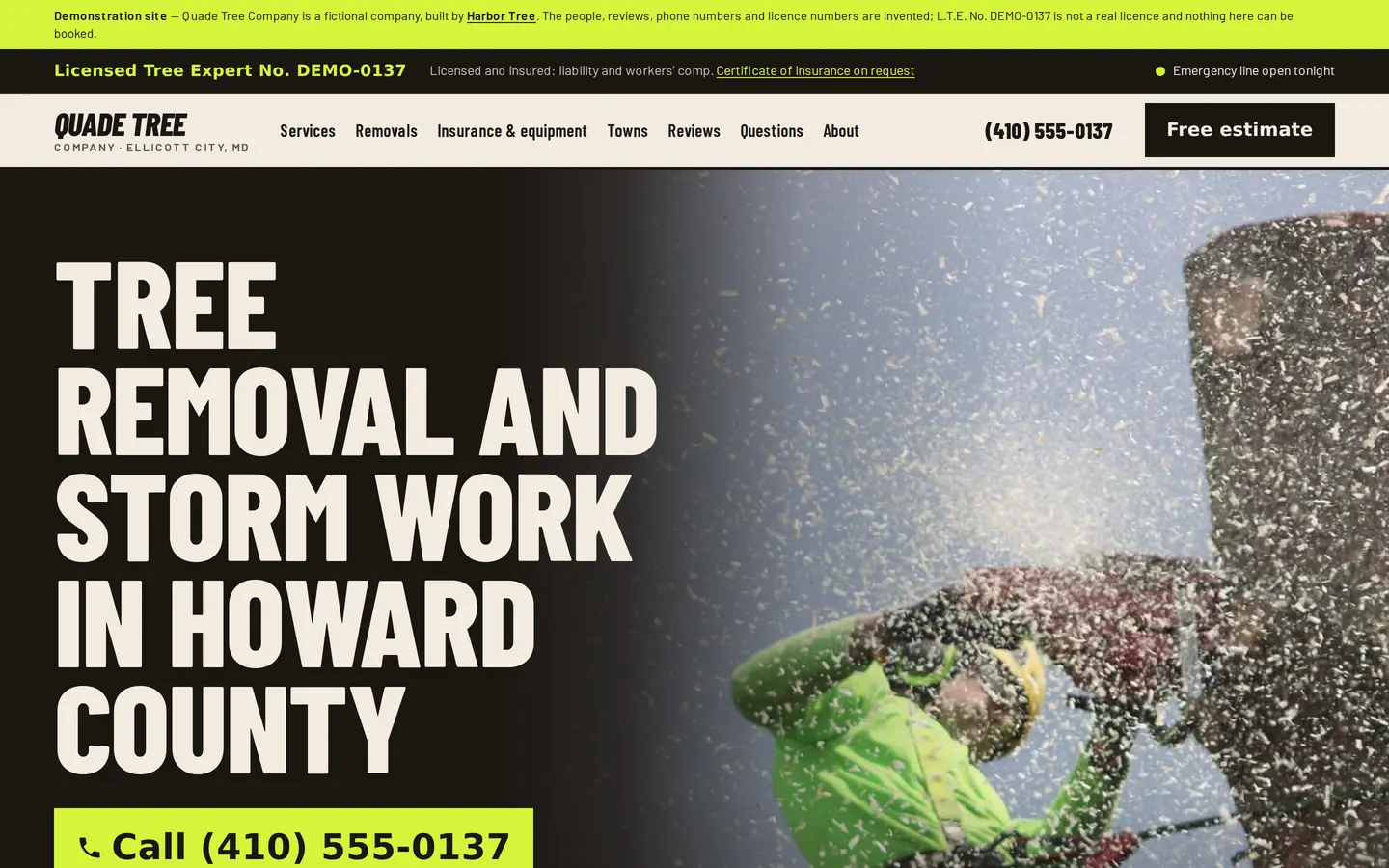
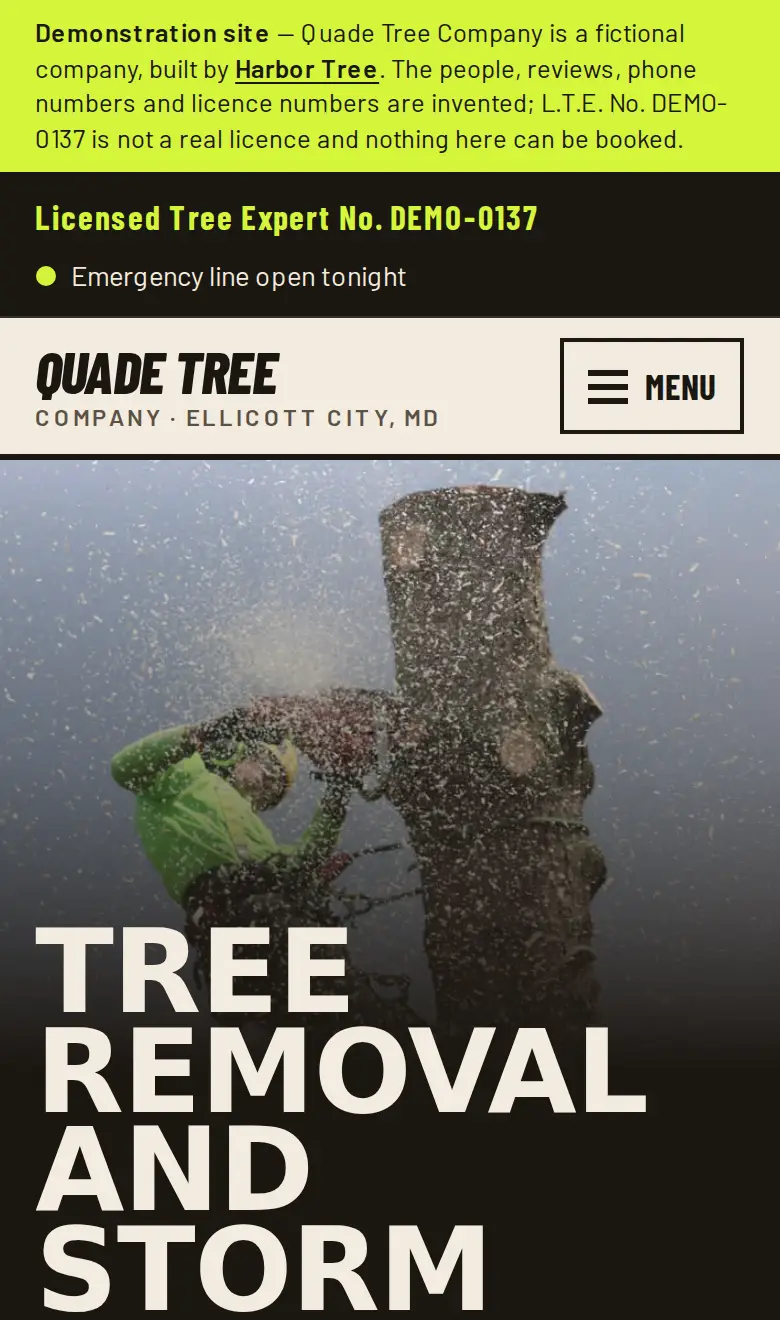
A complete tree company site we made from scratch to show the thinking in full, every page finished, that you can click through the way one of your customers would.

Quade Tree Company is invented — the people, the address, the phone number and every figure on it are made up, and the site is kept out of search results on purpose. It is there to be judged as work, not mistaken for a business.

Open the Quade Tree Company demo (opens in a new tab)

How tree companies get chosen

What actually happens before someone calls you

Storm calls go to the first company that looks real

A large share of tree work starts with a phone in the dark. A storm comes through, a limb is on the roof or a trunk is across the driveway, and the homeowner searches on a phone, often with the power out. That night they call the first company that looks real and answers, and the site has a few seconds to show a number they can tap, a plain line on when you take emergency calls, and the towns you will actually drive to.

Homeowners get two or three quotes, often that week

The rest of the work is slow and planned. A big oak leaning toward the house, a dead ash the neighbor keeps mentioning, a row of trees growing into the lines. These homeowners get two or three quotes, often in the same week, and the site has to show why yours is the one to take. They want to picture the job before anyone comes out: how the tree comes down, what happens to the lawn, whether the stump goes too. Photos of similar removals, reviews that mention a fair price and a clean yard, and a free-estimate request they can finish on a phone carry most of that conversation before the first visit.

In Maryland, the license number gets checked

Maryland adds a check most states do not. Paid work on any tree over 20 feet in Maryland needs a Licensed Tree Expert license from the DNR Forest Service, renewed every two years with insurance kept current, and the law requires the license number in every advertisement, websites included. After big storms DNR warns homeowners about unlicensed crews going door to door, some with a made-up license number on the truck, and points them to its public list of licensed experts. A license number near the top of the page answers the careful buyer, and the visitor who did not know to ask still reads it as a company with nothing to hide.

What they are really weighing is the risk to the house

Under all of it is risk. Tree work is the most dangerous job most homeowners will ever pay for, and the house, the car and the neighbor's fence are all in range. Before anyone signs, they want to know who pays if a limb goes the wrong way, what equipment the crew brings for a tree a climber should not be in, and whether the crew has done this beside a house before. A site that answers those plainly gets the call. One that says 'fully insured' and stops there leaves the worry where it was.

Paid lead sites share the homeowner; your site does not

Then there is what the calls cost you. Most small tree companies pay Angi, HomeAdvisor or Thumbtack for leads, and those sites charge for each one and often pass the same homeowner to several companies at once. A site with your own number on it, found under your name and your towns, brings the call straight to you, and nobody else is phoned with it.

Where these sites lose the job

Three things most tree companies’ sites get wrong

No license number anywhere on the site

The LTE number is on the truck and on the estimate, and missing from the one place a homeowner looks before calling. Maryland law requires it in every advertisement, and a website is one. After a storm, with unlicensed crews knocking on doors up and down the street, a site without it looks like one of them, however many years the company has held its license.

An emergency line that rings the office

The homepage says 24/7 emergency service, and the button dials a number that goes to voicemail at night, or there is no button at all, only a contact form. Someone with a tree through the roof at midnight will not fill in a form. They go back to the search results and call the next name.

Climbers in harnesses and nothing else

The gallery is a dozen shots of a climber in a canopy, taken from below, with no word on what the job was. A homeowner wants to see a tree like theirs coming down beside a house like theirs, and the yard once the crew had gone. Without that, the photos only say you climb trees, which every company in the county does.

What we’d build instead

What a tree company site has to do

Most of this fits any build. The extra service and town pages are priced on the add-on menu below. A company with several services and several towns usually fits Growth ($4,500), which is built for that many pages and includes the writing, rather than Foundation ($1,900) with a $225 add-on for every page past the eight it is scoped for.

  • License and insurance at the top of every page

    Your LTE number, written the way the law asks for it (“Licensed Tree Expert No.” or “L.T.E. No.” and the number), and “licensed and insured: liability and workers’ comp”, in the header or just under it, with a certificate of insurance on request. In Maryland this is checked early, and it decides whether the rest of the site gets read.

  • A free estimate as the main ask, on a form finished on a phone

    If your estimates are free, that is the ask on every page: a button that says so, and a form a homeowner can finish on a phone with the address, the tree, what is wrong with it, and the best time to call. Want homeowners to attach photos? That is quoted as an add-on before we build it.

  • The emergency hours you really keep, and a call button that reaches someone in them

    Tap to call on every page, a plain line on the hours you take emergency calls and any after-hours rate, and whether you work with the homeowner's insurance company after storm damage. Add a storm notice we can post for you, saying which areas you are working and how to get on the list. On a care plan it goes up by the next business day; with Priority access, within two business hours on a weekday.

  • Removals shown before and after

    The tree, where it stood against the house, and the yard once the crew left, with a line on how it came down. It is the evidence a homeowner wants about risk, and the clearest way to show you leave a property clean.

  • The equipment you actually run, shown

    Your own trucks, bucket, chipper and grinder (a crane only if you have one), which jobs need which, and how you protect the lawn and the driveway while you work. Somebody with a big tree leaning over the house wants to know you have the gear for it before they ask for a price.

  • Stump grinding, land clearing and seasonal work on their own pages

    Stump grinding, land and lot clearing, dead ash removal and storm cleanup are each searched for on their own. A page for each, with when it is best done, fills the calendar when the storm calls stop.

  • The towns you cover, named

    The counties and towns you will drive a crew and a chipper to, written out. Storm-night searches are usually a town name and the words tree removal, and a named list saves the call from forty minutes away.

Paired with a build

Which services do Maryland tree companies pair with a new website?

Tree companies mostly add the things that let a homeowner judge the job before anyone comes out, in the language they call in: more pages, a Spanish version, and a site that holds up through the busiest week of the year.

  • $225 per page

    Extra page

    A page for each job you want to be called about, such as stump grinding, land clearing, crane removals or dead ash, and one for each town your crews cover. Someone searching for tree removal in their own town is typing those words, and one Services page cannot be found for all of them.

    See the add-on menu
  • $395 one-time, then $45 per translated page

    Your site in Spanish

    Many Maryland tree crews are run by owners who speak Spanish first, and plenty of the homeowners who call them would rather talk in Spanish too. A Spanish version of every page, with Se habla español where a caller sees it first, says it in writing to the people searching for it.

    See the add-on menu
  • $199 a month

    Care Plus

    The week after a storm is your busiest of the year, and the worst week for the site to break. This plan answers a site that is down or broken the same business day on weekdays, gives you sixty minutes of edits a month for notices like that (answered by the next business day), and keeps security patched as flaws are published.

    What Care Plus covers

Already have a site? The Website Audit is $375 — a written verdict on whether it is worth improving, worth replacing or already fine, and the fee comes off whatever you do next. How the audit works

Not ready for either? Check your Google listing against your site — free, about ten seconds.

What it costs is the same whatever you do.

We price the build, not the industry — the same site costs the same whoever it is for. What each package includes sits on the websites page; what the market charges, and the terms we work on, sit on the pricing page.

Questions from tree companies

The ones we get asked most

Does the LTE number really need to be on the website? It's already on the trucks.

Yes. Maryland law requires it in every advertisement, and your website is one. It goes in your written contracts too, and the law sets the form: “Licensed Tree Expert No.” or “L.T.E. No.” followed by the number.

The truck is seen by people who have already called you. The site is seen by people deciding whether to. DNR keeps a public list of licensed experts, and a license drops off it if the insurance certificate lapses, so a careful buyer can check you in a minute. Two things belong in the header:

  • the LTE number, in the form the law asks for
  • “licensed and insured: liability and workers’ comp”, with a certificate of insurance on request

The same details go into the business information search engines read, which the SEO page explains.

Should we put prices on the site? Every tree is different.

Not per tree. A removal depends on height, lean, what is underneath and whether a crane can reach, and a figure that turns out wrong costs more trust than no figure.

What homeowners do want written down:

  • what an estimate includes, and whether it is free
  • how soon one comes back
  • whether stump grinding and haul-away are in the price

For simple, repeatable jobs like stump grinding, an instant estimate can give a range on the page. What we charge for the build itself is on the pricing page.

Most of our work comes after storms. How does a site help when we're already overloaded?

It sorts the calls before they reach you.

A storm notice at the top of the homepage, posted by us (by the next business day on a care plan, within two business hours on a weekday with Priority access), can say which areas you are working, whether you are taking new emergency jobs, and how to get on the list for cleanup once the urgent work is done.

The weeks after a storm matter too. That is when the planned removals it exposed get decided, and the company whose site showed the work is the one asked to quote.

Should the site mention ISA certification as well as the license?

Yes, if someone on the crew holds it. The two are different things.

The LTE license is the state's permission to be paid for work on trees over 20 feet in Maryland, renewed every two years with eight hours of continuing education and current insurance. One licensed expert supervising covers the crew. ISA certification is a voluntary credential from the International Society of Arboriculture, earned by exam and renewed every three years.

Name the certified arborist and give their number. Homeowners with a sick or valuable tree look for it, and it tells them who will actually assess the tree.

If you also handle roadside tree permits, say so. Work on a tree in the public right-of-way needs a Roadside Tree Permit from DNR, done by or under a Licensed Tree Expert, and either the homeowner or the tree company can apply. Montgomery County requires its own permit as well, and Baltimore City has its own street-tree permits. Our county pages cover how we build for each area.

Still holding a question this did not answer? The full FAQ covers what a build costs, how long it takes and what happens after launch — or write to us and you will get a plain-language answer from the person who would build it.

Start a project

Ready for a site
that wins the job?

Tell us what you're working with. You'll get a plain-language reply — and if we're not the right fit, we'll say so and point you somewhere good.

Don't like the first design? Take your money back. What it covers

Want the number first? Build an estimate — a minute, and no email needed.

Not ready? Check your Google listing — free, about ten seconds.

Prefer email? contact@theharbortree.com

Tell us what you need

A few lines. Takes about a minute.

If we miss you, we leave a voicemail saying it's Harbor Tree.

Best way to reach you

No newsletters, no spam. Your details go straight to us, and a phone number is only used to reply to this message.