Skip to content
Harbor Tree

Websites for heating and plumbing companies

Website design for HVAC and plumbing companies.

No heat at six in the morning. Nobody is building a shortlist — they are calling whoever answers and can name a time.

Fixed price from $1,900 · 3–6 weeks · you own it outright

The short version

What your site has to do

  • A tappable number pinned to every page
  • An after-hours policy written out plainly
  • A page for each failure people search by name

See all 5 and why each one matters for heating and plumbing companies.

Builds start at
$1,900
Typical turnaround
3–6 weeks
Who owns it
You do, outright

Already have a site? See what a machine makes of it.

When something has just failed, the only thing your page has to get right is whether the number can be tapped without pinching in first. Our free check reads one page the way a search engine and a screen reader do, and tells you plainly what it found — about ten seconds, no account, and no email needed to see the results.

Proof

A finished site you can click through

Demonstration build

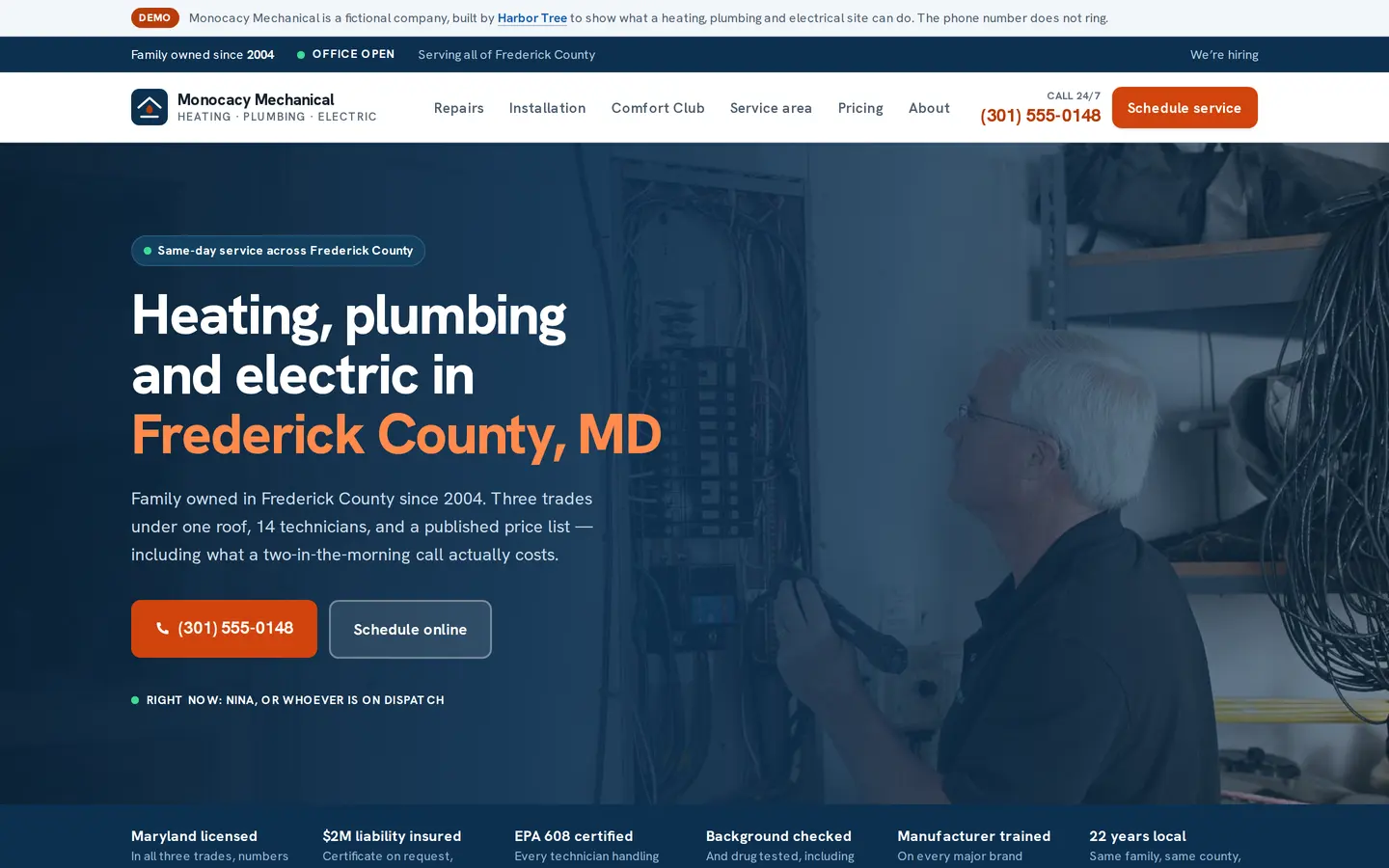
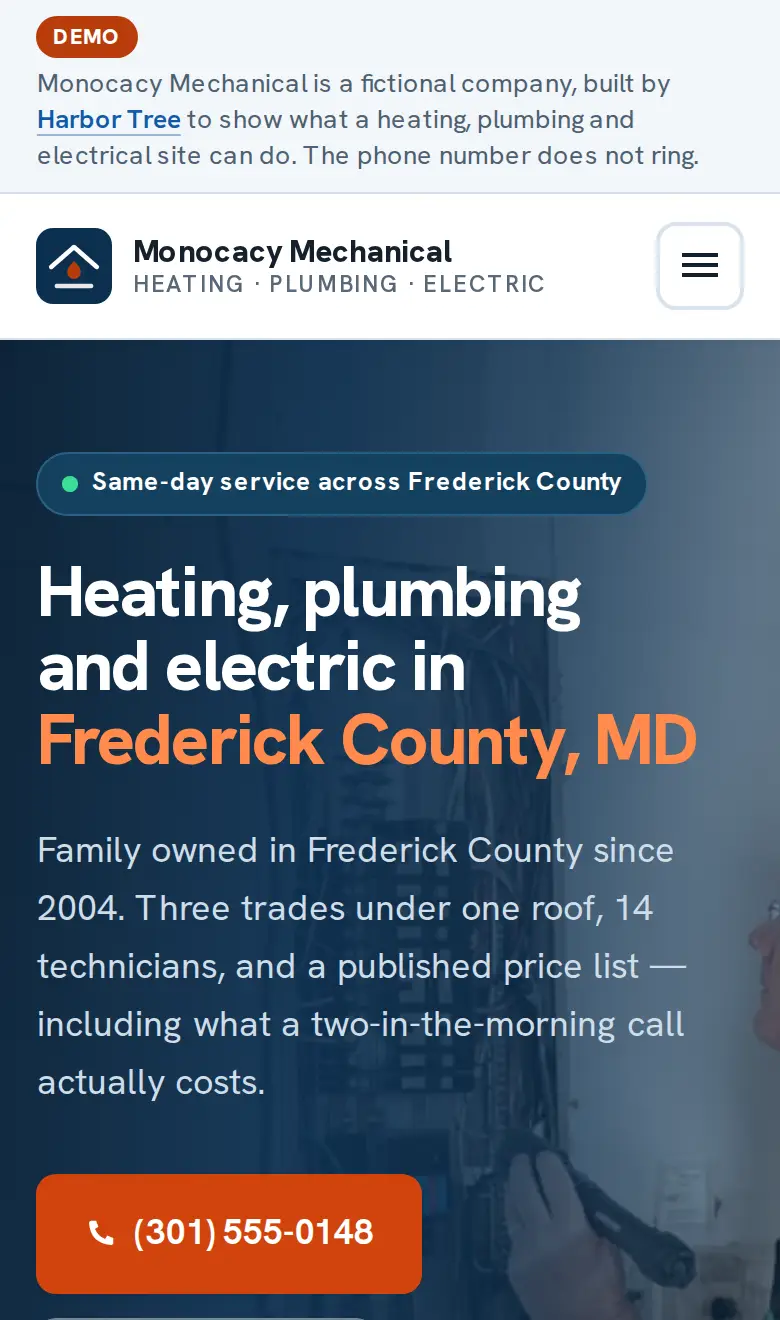
Monocacy Mechanical

We haven’t been hired by heating and plumbing companies yet. Rather than imply otherwise, we built one: a complete heating and plumbing company site, every page finished, that you can click through the way one of your customers would.

Monocacy Mechanical is invented — the people, the address, the phone number and every figure on it are made up, and the site is kept out of search results on purpose. It is there to be judged as work, not mistaken for a business.

Open the Monocacy Mechanical demo (opens in a new tab)

How heating and plumbing companies get chosen

What actually happens before someone calls you

They are standing in it, holding a phone one-handed

There is water coming through a ceiling, or no heat on the coldest morning of the year, or an outlet that has started to smell hot. Whoever is searching is standing in it, holding a phone one-handed, and they are not assembling a shortlist. They open the first result, and if that first screen does not tell them to dial, they are back on the results page within seconds and on to the next one. Nobody leaves a voicemail about a burst pipe.

Can I tap this, will anyone answer, do you fix it

The whole decision compresses into three questions asked almost at once: can I tap this number, will anyone answer at this hour, and do these people fix the thing that has broken. A heating company that also clears drains still loses the drain call if no page says so. There is no comparison here, no partner to consult, no second sitting a week later — there is one screen, and it produces either a call or a back button.

The emergency is not the money — the replacement is

What makes it worth building properly is what comes afterwards. The emergency call is rarely the money; the replacement is. The furnace nursed through February gets replaced in April, and that decision does behave like a considered purchase — weeks of reading about efficiency, warranties and rebates — and it is usually won by whoever turned up in the emergency. A site with only one gear serves the panicked visitor and abandons the researching one, or the reverse, and either way it drops the half of the business that pays for the trucks.

Eight months later they search for the green van

Then there is a job specific to this trade: being found a second time. Homeowners rarely remember company names. They remember the plumber with the green van, and eight months later they search something approximating that when the next thing fails. Whether they land back on you or on whoever is advertising hardest that week is decided by how findable your own name, vans and technicians are on your own pages — which is why a site built as one image-heavy homepage quietly loses the customers you already earned.

Where these sites lose the job

Three things most heating and plumbing companies’ sites get wrong

A phone number you cannot tap

Set as an image, stranded in the footer, or written as plain text a phone will not dial. Someone one-handed in a basement with wet sleeves is not typing ten digits into a keypad — they are going back to the results, where three competitors put a tappable number in the listing itself.

A 24/7 promise the contact page contradicts

The banner offers round-the-clock emergency service and the contact page below it lists Monday to Friday, eight until five. It is the most-copied claim in the trade, homeowners have learned to discount it on sight, and the site ends up making a promise it cannot keep while getting no credit for making it.

No page for the thing that just broke

A search for a leaking water heater lands on a homepage listing twelve services in one paragraph. Nothing there confirms you handle water heaters specifically, nothing describes what that visit involves, and nothing on the site was ever going to rank for the search that produced the visitor.

What we’d build instead

What a heating and plumbing company site has to do

  • A tappable number pinned to every page

    Emergency traffic lands on whichever page matched the search, never the homepage, and it converts by thumb in seconds. The number belongs in the same place on all of them, above everything else, dialable in one tap.

  • An after-hours policy written out plainly

    Which hours reach a person, which reach the technician on call, and what a Sunday call actually gets you. Every competitor claims round-the-clock; being the one that says what that means in practice is worth more than the claim.

  • A page for each failure people search by name

    Furnace not igniting, water heater leaking, breaker tripping, drain backing up. Each is its own search, typed at two in the morning, and each needs a page carrying that exact phrase — to be found by it, and to be believed once it is.

  • A coverage map with the after-hours radius drawn separately

    The area you cover on a Tuesday afternoon and the area you will drive to at midnight are rarely the same shape, and someone forty minutes out needs to know which one they are standing in before they dial.

  • A replacement section built for the slow decision

    The emergency is how you meet them; the system replacement is the job worth having. Those visitors read for weeks about efficiency, warranty and rebates, and they need pages the panicking visitor would never open.

Paired with a build

Which services do Maryland heating and plumbing companies pair with a new website?

One site, two jobs: being tapped at six in the morning, and being found again eight months later. Nearly everything added to a build here is aimed at the second one.

  • $225 per page

    Extra page

    Every failure is its own search, typed at two in the morning — furnace not igniting, water heater leaking, breaker tripping, drain backing up. Each needs a page carrying that exact phrase, or the search that produced the visitor lands on somebody else.

    See the add-on menu
  • $349 one-time

    Logo & brand refresh

    Homeowners do not remember company names. They remember the plumber with the green van, and they search for something like it eight months later. A mark that reads the same on the truck, the invoice and the site is what makes that search land on you.

    See the add-on menu
  • $199 a month

    Care Plus

    The emergency call is not where the money is; the replacement months later is. Staying visible across that gap is the whole job, and it is the one thing a site cannot do by sitting still after launch.

    What Care Plus covers

Already have a site? The Website Audit is $375 — a written verdict on whether it is worth improving, worth replacing or already fine, and the fee comes off whatever you do next. How the audit works

Not ready for either? Check your Google listing against your site — free, about ten seconds.

What it costs is the same whatever you do.

We price the build, not the industry — the same site costs the same whoever it is for. What each package includes sits on the websites page; what the market charges, and the terms we work on, sit on the pricing page.

Questions from heating and plumbing companies

The ones we get asked most

Our emergency work all comes from the map listing. Doesn't that make the site beside the point?

The listing wins the tap. The site still has to win the call.

A large share of those taps go through to a page before anyone dials, and what that page says about your hours, your trades and your coverage is what decides it.

The listing also leans on the site behind it — the two are not separate assets, and the weaker one caps the stronger.

Should we advertise 24/7 if we're honestly not?

No — and the specific answer outperforms the bigger one.

Say exactly how it works:

  • calls before six reach the office
  • anything later goes to whoever is carrying the phone that night
  • Sunday is emergencies only

A homeowner let down once by a banner promise reads the exact version as the one written by somebody who intends to keep it.

We do HVAC, plumbing and electrical. Is that one site or three?

One site, with each trade given its own section and its own service pages.

Three sites divides everything you have earned across three domains and triples what you maintain.

One undifferentiated list is worse — a homeowner searching for a plumber should not have to work out whether you are really a heating firm who will send someone eventually.

We run two trucks. Won't a better site bring in more work than we can cover?

It brings in better-matched work, which is what a small shop is usually short of.

Pages that state your trades, your radius and your after-hours policy turn work away before it becomes a call somebody has to take and apologize for:

  • the commercial job you do not want
  • the address an hour past your edge
  • the trade you quietly subcontract

Still holding a question this did not answer? The full FAQ covers what a build costs, how long it takes and what happens after launch — or write to us and you will get a plain-language answer from the person who would build it.

Start a project

Ready for a site
that wins the job?

Tell us what you're working with. You'll get a plain-language reply — and if we're not the right fit, we'll say so and point you somewhere good.

Don't like the first design? Take your money back. What it covers

Want the number first? Build an estimate — a minute, and no email needed.

Not ready? Check your Google listing — free, about ten seconds.

Prefer email? contact@theharbortree.com

Tell us what you need

Three fields. Takes about thirty seconds.

No newsletters, no spam — your details go straight to us and nowhere else.