Skip to content
Harbor Tree

Websites for salons

Website design for salons and barbershops.

Nobody chooses a salon. They choose one person, for a result they will be wearing to work every day for six weeks.

Fixed price from $1,900 · 3–6 weeks · you own it outright

The short version

What your site has to do

  • A portfolio indexed by the hair and the hand
  • Stylists findable by their own names
  • A service menu measured in hours

See all 5 and why each one matters for salons.

Builds start at
$1,900
Typical turnaround
3–6 weeks
Who owns it
You do, outright

Already have a site? See what a machine makes of it.

Salon pages travel by screenshot and share, and how one looks when it lands somewhere else is decided by markup rather than by the photography. Our free check reads one page the way a search engine and a screen reader do, and tells you plainly what it found — about ten seconds, no account, and no email needed to see the results.

Proof

A finished site you can click through

Demonstration build

Carder

We haven’t been hired by salons yet. Rather than imply otherwise, we built one: a complete salon site, every page finished, that you can click through the way one of your customers would.

Carder is invented — the people, the address, the phone number and every figure on it are made up, and the site is kept out of search results on purpose. It is there to be judged as work, not mistaken for a business.

Open the Carder demo (opens in a new tab)

How salons get chosen

What actually happens before someone calls you

They are replacing a pair of hands, not a salon

The search usually starts because a relationship ended. Somebody moved, or their stylist moved, or the last cut was wrong in a way they could not describe over the phone. Whatever the trigger, the person searching is not shopping for premises — they are trying to replace a specific pair of hands, and they already know from experience that the chair matters far more than the sign above the door. It is why so many of these searches carry a person's name in them rather than a business's.

They look for their own hair, and read absence as no

What follows is a hunt for evidence about themselves. Not 'do they do color' but: has anyone here taken hair this dark this light without wrecking it, cut curl this tight dry rather than wet, worked with hair this fine at this length, blended gray without it going flat. A new client is handing their appearance — the thing everybody they know will see tomorrow — to a stranger for weeks, and it cannot be returned or quietly redone the next morning. So they look for their own head somewhere in the work, and where they cannot find it they assume the answer is no.
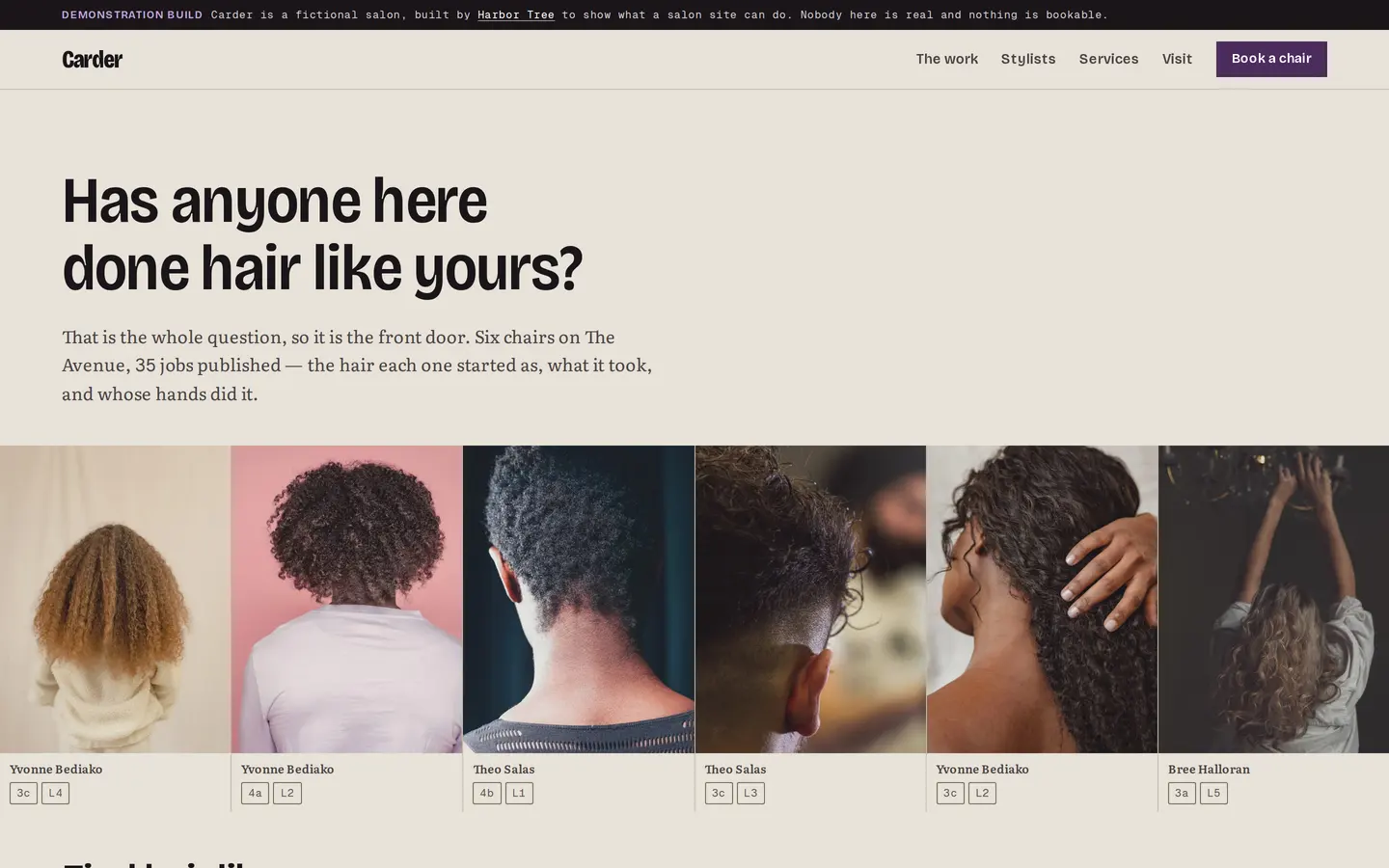
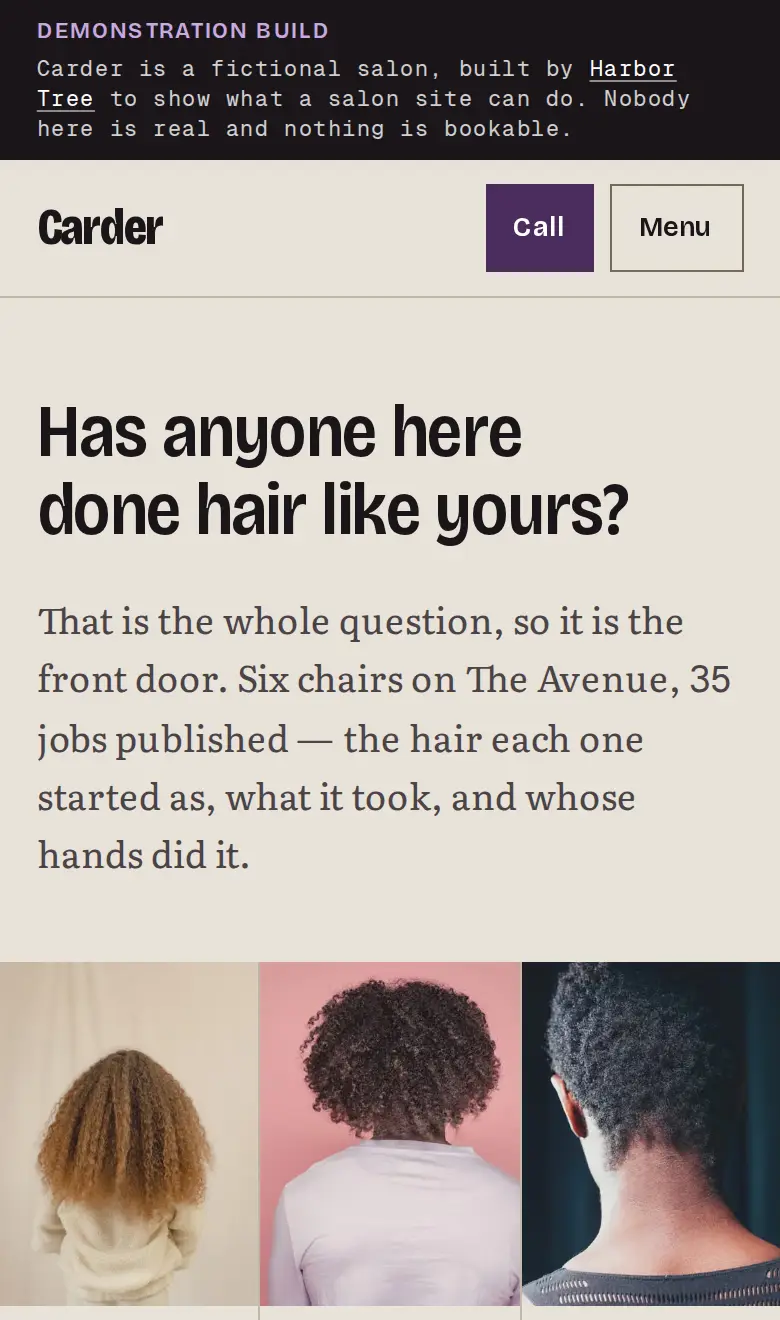
A photograph with no name under it proves nothing

That evidence is worth very little unattached to a name. Ten beautiful heads of hair in a gallery prove the salon employs somebody good; they do not tell a visitor whether the person holding Thursday at four is that somebody. The question actually being asked is compound — has this particular person done this particular thing on hair like mine — and a site organized the usual way, as Cut, Color, Balayage and Treatments, cannot answer it however good the photographs on it are.

A first appointment is worth years of appointments

The last piece is time. Few local services are bought in blocks of the customer's day the way this one is: the same word on a price list means ninety minutes on one head and most of a Saturday on another, and a first-timer who books the short version of what they actually need has cost the chair either the result or the difference. The decision, once it goes well, is also unusually durable — people stay with a stylist through house moves, price increases and pregnancies. A first appointment is therefore worth years of appointments, which makes it strange how much of it turns on whether one photograph had a name written under it.

Where these sites lose the job

Three things most salons’ sites get wrong

Work in the gallery credited to nobody

The photographs are real and the work is good, and not one image says whose hands did it or links anywhere. A visitor who has just found the exact result they came for has no way to ask for it by name, so the most persuasive thing the salon owns has been hung on the wall as decoration.

A service list that never says how long

Cut and finish, color, balayage, treatment — each one named, none of them timed. The same word covers ninety minutes and most of a day depending on the head it is done to, so a new client picks whichever entry sounds closest, books the wrong length of appointment, and somebody absorbs the difference.

A roster still listing the stylist who left in spring

Somebody arrives having been told to ask for a particular person and finds three names, two of them gone since last year and none of them the one they were sent for. Nothing on the page carries a date, so a visitor who spots one stale fact starts doubting the hours, the services and the rest of it.

What we’d build instead

What a salon site has to do

  • A portfolio indexed by the hair and the hand

    Visitors arrive with one compound question — has this person done this on hair like mine — so the work has to sort both ways at once: texture, length and starting color on one axis, and the stylist who did it on the other.

  • Stylists findable by their own names

    A following searches for the stylist, not the salon. Giving each chair a page carrying that name, their specialties, the work that is genuinely theirs and a way to book them is what makes your domain the place that search lands.

  • A service menu measured in hours

    Every service with an honest time block and a plain line on what stretches it — length, density, how much color is already on the hair. That is the difference between a booking that fits the day and one that breaks the two after it.

  • A booking screen that keeps the stylist you chose

    The visitor chose a person out of a photograph. A booking screen that opens on a blank service list throws that choice away and asks them the question they just answered, and it has to say which stylists are taking new clients at all.

  • What you take on, and what you send elsewhere

    The textures and hair types your team is trained on, named positively and in detail — alongside the color corrections you will not rush and the extension systems you do not fit. Both halves cost one inquiry and save a chair held for something that was never going to fit inside it.

Paired with a build

Which services do Maryland salons pair with a new website?

What a salon adds nearly always comes down to two things: whose hands did the work, and whether the site feels like the room the work happens in.

  • $225 per page

    Extra page

    A page for each stylist, carrying their own name. A following searches for the person rather than the salon, and a named page is what makes your domain the place that search lands instead of somewhere you do not own.

    See the add-on menu
  • $99 a month

    Care

    A roster goes stale faster than anything else on a salon site, and a visitor who spots the stylist who left in spring starts doubting the hours and the prices too. Care is what keeps the chairs on the page current.

    What Care covers
  • $349 one-time

    Logo & brand refresh

    This is a business bought on look before a word is read. Getting the mark on the window, the price list and the site to be one thing rather than three is worth more here than in almost any other trade.

    See the add-on menu

Already have a site? The Website Audit is $375 — a written verdict on whether it is worth improving, worth replacing or already fine, and the fee comes off whatever you do next. How the audit works

Not ready for either? Check your Google listing against your site — free, about ten seconds.

What it costs is the same whatever you do.

We price the build, not the industry — the same site costs the same whoever it is for. What each package includes sits on the websites page; what the market charges, and the terms we work on, sit on the pricing page.

Questions from salons

The ones we get asked most

Our stylists rent their chairs. If each of them gets a page, aren't we helping them leave?

They leave anyway, and the following travels with them either way.

That is the trade, not something a website causes. What the site decides is where their name resolves while they are still with you.

If searching a stylist lands on your domain, the salon collects every one of those visits, and the renters have a reason to stay somewhere that sends them work.

A roster with no names on it keeps nobody. It only means the search lands somewhere you do not own.

Won't a portfolio of our best work set new clients up to be disappointed?

Only when the result is published with no starting point attached.

Put the before beside the after, and say what it took — two sessions, box color lifted out first, hair that arrived in good condition. The same photograph stops reading as a promise and starts reading as a description of a process.

It makes the consultation easier too, because the client sitting down already knows theirs may take a different number of visits. Whether a specific head can get there at all is your stylist's judgment on the day, and the page should say so plainly.

Can we put client photographs on the site?

With permission, in writing — far easier to get at the chair than to chase afterwards.

  • Hair does not need a face to be legible, so the back of the head is often the version people agree to immediately, and the one that shows the work better anyway.
  • Never use one client's photograph to sell a service they did not have.

License posting, sanitation notices and whatever else is currently listed are set by your state cosmetology board — a list that is not the same in two states and does not stay still.

Nobody building the site should be the one telling you what it says. What the build is answerable for is that those notices have a designed place to sit, rather than a corner they get wedged into last.

We're a barbershop, not a salon. Does any of this change?

The shape of it does. The part that matters does not.

What changes: appointments are shorter, a good share of the day is walk-in, and the hair-type question is really about patterns and beard work — whether you cut coily hair well, whether the fades on the site look like the one being asked for.

What does not: the client is choosing a barber rather than a shop, arrives already wanting a particular chair, and a site with no names on it hands that decision straight back to them unanswered.

We're a day spa. Does a site built around named stylists work for treatment rooms?

Two things swap places.

The individual matters less — plenty of spa clients will happily take whoever is free — so the weight moves onto the treatment pages, and those have to answer what a brochure line never does:

  • how much of a booked hour is hands-on, rather than changing and consultation
  • what is worn or removed and how draping works, which is the question people are too awkward to phone and ask
  • which conditions rule a treatment out altogether, since discovering a pregnancy or recent injectables at the door wastes a room

The call on any individual client stays with whoever is treating them. Gift certificates want their own route too; they are bought by somebody who will never be in the room.

Still holding a question this did not answer? The full FAQ covers what a build costs, how long it takes and what happens after launch — or write to us and you will get a plain-language answer from the person who would build it.

Start a project

Ready for a site
that wins the job?

Tell us what you're working with. You'll get a plain-language reply — and if we're not the right fit, we'll say so and point you somewhere good.

Don't like the first design? Take your money back. What it covers

Want the number first? Build an estimate — a minute, and no email needed.

Not ready? Check your Google listing — free, about ten seconds.

Prefer email? contact@theharbortree.com

Tell us what you need

Three fields. Takes about thirty seconds.

No newsletters, no spam — your details go straight to us and nowhere else.