Skip to content
Harbor Tree

Websites for real estate agents

Website design for real estate agents.

A seller is about to hand somebody the keys to the biggest thing they own. Your site is the one sample of your marketing no portal template has flattened.

Fixed price from $1,900 · 3–6 weeks · you own it outright

The short version

What your site has to do

  • A sold archive that outlives the listing
  • One property page built as the work sample it is
  • Neighborhood pages only somebody local could write

See all 5 and why each one matters for real estate agents.

Builds start at
$1,900
Typical turnaround
3–6 weeks
Who owns it
You do, outright

Already have a site? See what a machine makes of it.

Your pages get shared into messages and feeds long before anyone calls, and what they show when they land there is set by markup most agents never see. Our free check reads one page the way a search engine and a screen reader do, and tells you plainly what it found — about ten seconds, no account, and no email needed to see the results.

Proof

A finished site you can click through

Demonstration build

Adair Modern

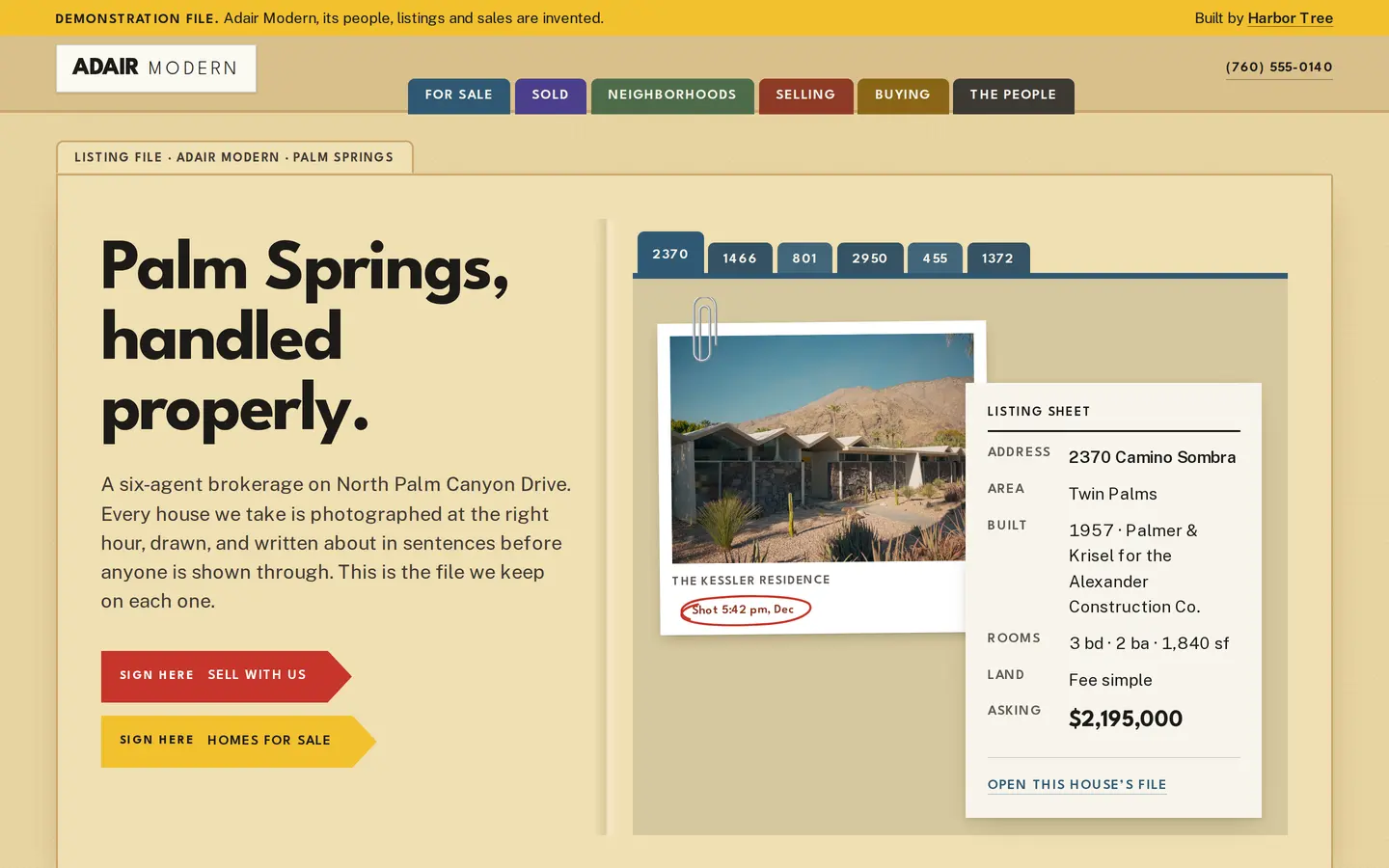
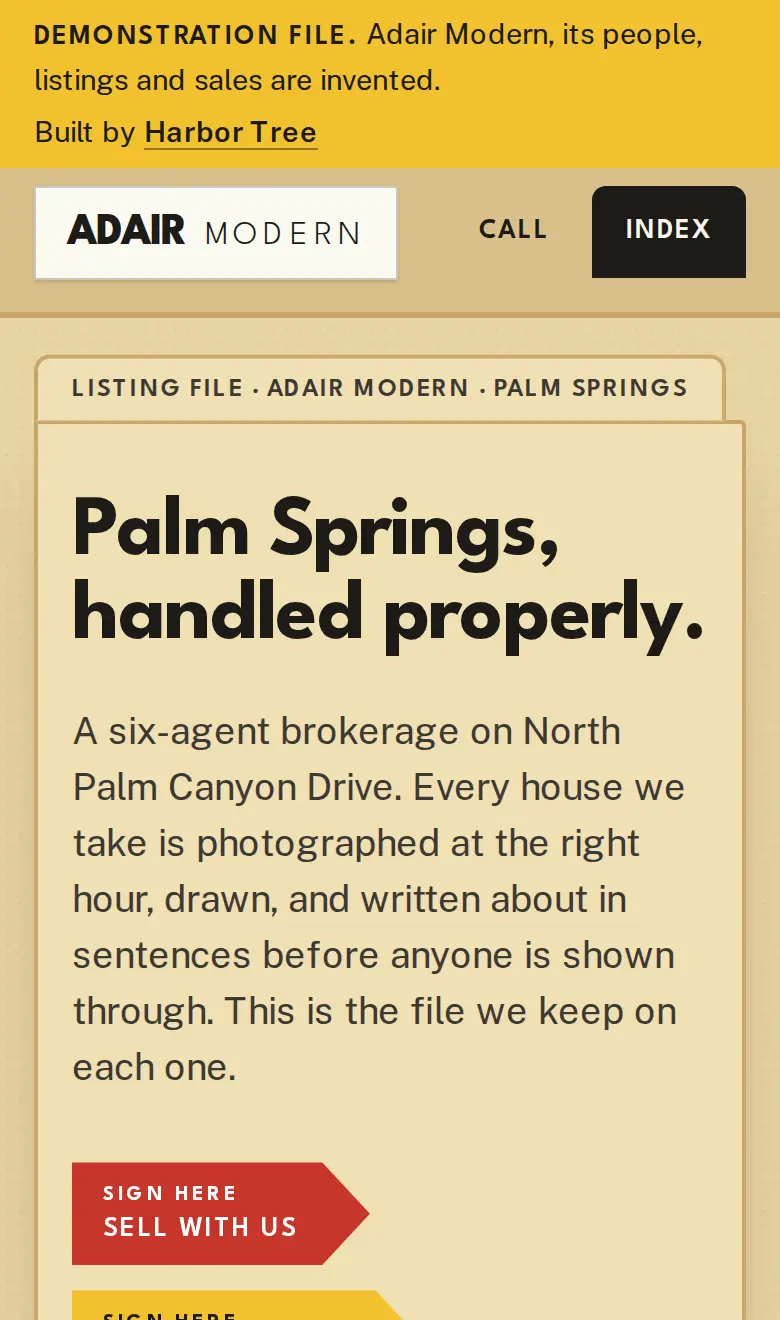
We haven’t been hired by real estate agents yet. Rather than imply otherwise, we built one: a complete real estate agent site, every page finished, that you can click through the way one of your customers would.

Adair Modern is invented — the people, the address, the phone number and every figure on it are made up, and the site is kept out of search results on purpose. It is there to be judged as work, not mistaken for a business.

Open the Adair Modern demo (opens in a new tab)

How real estate agents get chosen

What actually happens before someone calls you

Nobody invites a brokerage over; they invite a person

The decision worth building for is the seller's. A homeowner starts a long way out — a year of half-noticing what things went for on the street, then two weeks of working out who to invite over. Two or three agents get through the door, each leaves a presentation on the kitchen table, and one of them walks away with a months-long exclusive on the largest asset the household owns. The brokerage name is on the sign outside, but nobody invites a brokerage over; they invite a person whose name somebody said out loud.

Your listings preview how theirs will be handled

That decision has a feature almost no other local hire does. A seller is hiring somebody to market a property, and they can go and look at that person's marketing before signing anything. Everywhere else it appears — the portal listing, the aggregator card, the syndicated feed — a template has already flattened it into the same shape as every other agent's. Your own pages are the one place the choices are all yours: how a listing is photographed, how the description is written, whether the floor plan is there at all, whether the thing is a chore to use. A seller reads all of it as a preview of what their house will look like in your hands, which makes a site that presents other people's homes poorly a demonstration of the service rather than a description of it.
Buyers arrive from portals to work out who you are

The other visitor is a buyer, and buyers do not begin here. They begin on the portals, which carry every listing in the county and will always beat one agent at showing inventory. What a buyer actually uses your pages for is narrower: working out whether to reply to you, whether you know the streets they are circling, whether you will be any use on the Tuesday something appears and is under contract by Friday. That is a question about you, which no portal was ever built to answer.

Inventory expires in weeks; what you know does not

Two things then work against the average agent online. Most sites are the template the brokerage hands out — the same layout as four hundred colleagues, with the agent's name in the one field they were permitted to fill in. And most are built entirely around live inventory, so an agent with eleven years of local sales shows up in February as somebody with two listings or none. Inventory expires within weeks. What wins the listing appointment — what you have sold nearby, what you know about the street, what happens in the months after somebody signs — does not expire at all.

Where these sites lose the job

Three things most real estate agents’ sites get wrong

A homepage that is somebody else's listing feed

The first screen is a property search returning the same records as the portals already open in the seller's other tabs, and the agent appears once, as a headshot in the corner. Nothing on it is evidence about the person being hired, which was the whole reason that page existed.

A listings page that says 'no current listings'

Sold homes drop off the site the day they close, so the entire record of what an agent has done exists only while it is still for sale. A seller arriving in a quiet month reads an empty page as an empty career, and there is nothing anywhere on the site to correct them.

Neighborhood pages written from the census

Population counts, a paragraph of local history, a school-rating widget and a median statistic — an area page assembled entirely out of things a stranger could have looked up. It proves no local knowledge whatsoever, because anybody in the county could publish the identical page, and several have.

What we’d build instead

What a real estate agent site has to do

  • A sold archive that outlives the listing

    The record of what you have actually sold, kept by neighborhood and property type long after each sale closed. It is the evidence a seller came looking for, and live inventory carries it only by accident and only in the months you have some.

  • One property page built as the work sample it is

    A seller judges how their house will be presented by looking at how somebody else's was. Full photography, floor plan, written description and map, on a page you control, shows them what you would do for their home instead of telling them about it.

  • Neighborhood pages only somebody local could write

    Local knowledge is the one claim on an agent's site a competitor cannot simply copy, and it becomes believable only in specifics — which streets flood, where an attendance zone actually runs, what a given HOA board will and will not approve. Written within whatever your broker's advertising and fair housing rules allow: those are theirs to set, and the pages are built to hold them.

  • A seller's timeline covering the next twelve weeks

    Somebody is tying themselves to one agent for months on the strength of two meetings, and the fear is being left with a person who then goes quiet. Setting out the pricing conversation, prep, photography, launch, showings, offer and close is what makes the appointment easy to grant.

  • Two front doors, one for sellers and one for buyers

    The most valuable visitor on the site and the most casual one currently share a single Contact box. Separate paths let a homeowner ask for a valuation and a buyer ask about a showing without either having to explain which they are first.

Paired with a build

Which services do Maryland real estate agents pair with a new website?

Everything an agent adds here is about outliving a listing — the sold work, the neighborhoods and the name on the door, none of which a portal feed keeps for you.

  • $225 per page

    Extra page

    A neighborhood page for each area you genuinely work, and a full property page for each sale worth showing. Both keep earning long after the listing expires, which is the half of your record no feed holds on to.

    See the add-on menu
  • $449 one-time

    Copywriting

    A seller is judging how their house will be described by reading how you described somebody else's. If the writing is the work sample, it is worth having it drafted properly rather than at eleven at night between showings.

    Included with Growth and Signature.

    See the add-on menu
  • $349 one-time

    Logo & brand refresh

    If you ever leave the brokerage, the only identity that travels with you is your own. A mark, a palette and type that are yours rather than the office's turn that move into a swap instead of a restart.

    See the add-on menu

Already have a site? The Website Audit is $375 — a written verdict on whether it is worth improving, worth replacing or already fine, and the fee comes off whatever you do next. How the audit works

Not ready for either? Check your Google listing against your site — free, about ten seconds.

What it costs is the same whatever you do.

We price the build, not the industry — the same site costs the same whoever it is for. What each package includes sits on the websites page; what the market charges, and the terms we work on, sit on the pricing page.

Questions from real estate agents

The ones we get asked most

If I leave my brokerage, what happens to the site?

It comes with you — and that is the main argument for having your own.

The site the office supplies lives on the office's domain and ends the day you leave, taking with it every page a search engine had learned about and every link anyone ever shared.

On a domain in your name, moving is a logo swap, a new address block and an update to the brokerage identification your state requires you to display.

The site is advertising in the regulatory sense, and your broker sets what has to appear on it. The years of work sitting behind all that never move.

Buyers all start on the portals. Can my site compete with them?

No, and it should not try.

Portals win the inventory search by aggregating the whole market at once, which an agent holding four properties cannot.

Your pages win the question a portal will not answer: who this person is, whether they know the street, what they would actually do for a seller.

There is a second difference worth noting. On a portal your listing sits surrounded by ads for rival agents. On your own pages you are the only agent in the room.

Do I need an MLS or IDX search on my site?

Usually not as the centerpiece, and often not at all.

It carries a recurring license, it is slow, and it turns your homepage into a poorer version of a site the visitor already has open in another tab.

If you do want it, put it behind the pages that do the persuading — the sold archive, the neighborhoods, the process — rather than in front of them, where it displaces the reason anybody came to you instead of a portal.

I sell a handful of homes a year. Isn't a proper site overkill?

It is the other way around.

A low-volume agent has no name recognition to fall back on and far fewer listing appointments to lose, so each one carries more weight. The site does not have to be large either:

  • a sold archive
  • three or four neighborhood pages you can genuinely write
  • a seller's process page
  • a clear way to be reached

Our pricing page sets out what that scale of build comes to.

Still holding a question this did not answer? The full FAQ covers what a build costs, how long it takes and what happens after launch — or write to us and you will get a plain-language answer from the person who would build it.

Start a project

Ready for a site
that wins the job?

Tell us what you're working with. You'll get a plain-language reply — and if we're not the right fit, we'll say so and point you somewhere good.

Don't like the first design? Take your money back. What it covers

Want the number first? Build an estimate — a minute, and no email needed.

Not ready? Check your Google listing — free, about ten seconds.

Prefer email? contact@theharbortree.com

Tell us what you need

Three fields. Takes about thirty seconds.

No newsletters, no spam — your details go straight to us and nowhere else.