Skip to content
Harbor Tree

Websites for law firms

Website design for law firms.

Someone was served papers this afternoon. They are reading about you alone, late, before they have told anybody.

Fixed price from $1,900 · 3–6 weeks · you own it outright

The short version

What your site has to do

  • A page per matter, written in the client's words
  • Attorney bios that answer 'have you handled mine before'
  • Fee structure stated as structure, not figures

See all 5 and why each one matters for law firms.

Builds start at
$1,900
Typical turnaround
3–6 weeks
Who owns it
You do, outright

Already have a site? See what a machine makes of it.

A practice-area page that reads perfectly well to you can still hand a search engine nothing to work with but the firm's name. Our free check reads one page the way a search engine and a screen reader do, and tells you plainly what it found — about ten seconds, no account, and no email needed to see the results.

Proof

A finished site you can click through

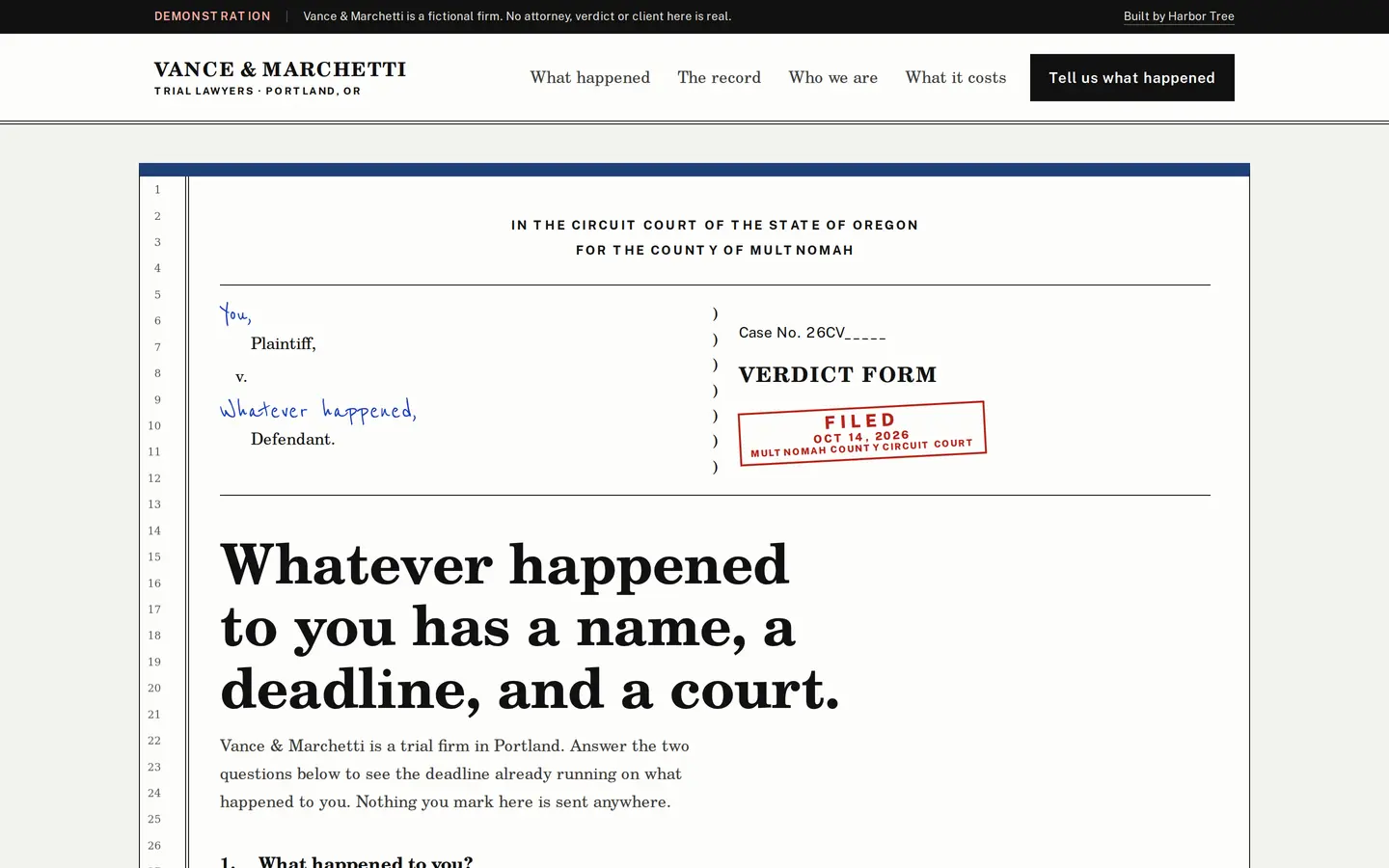
Demonstration build

Vance & Marchetti

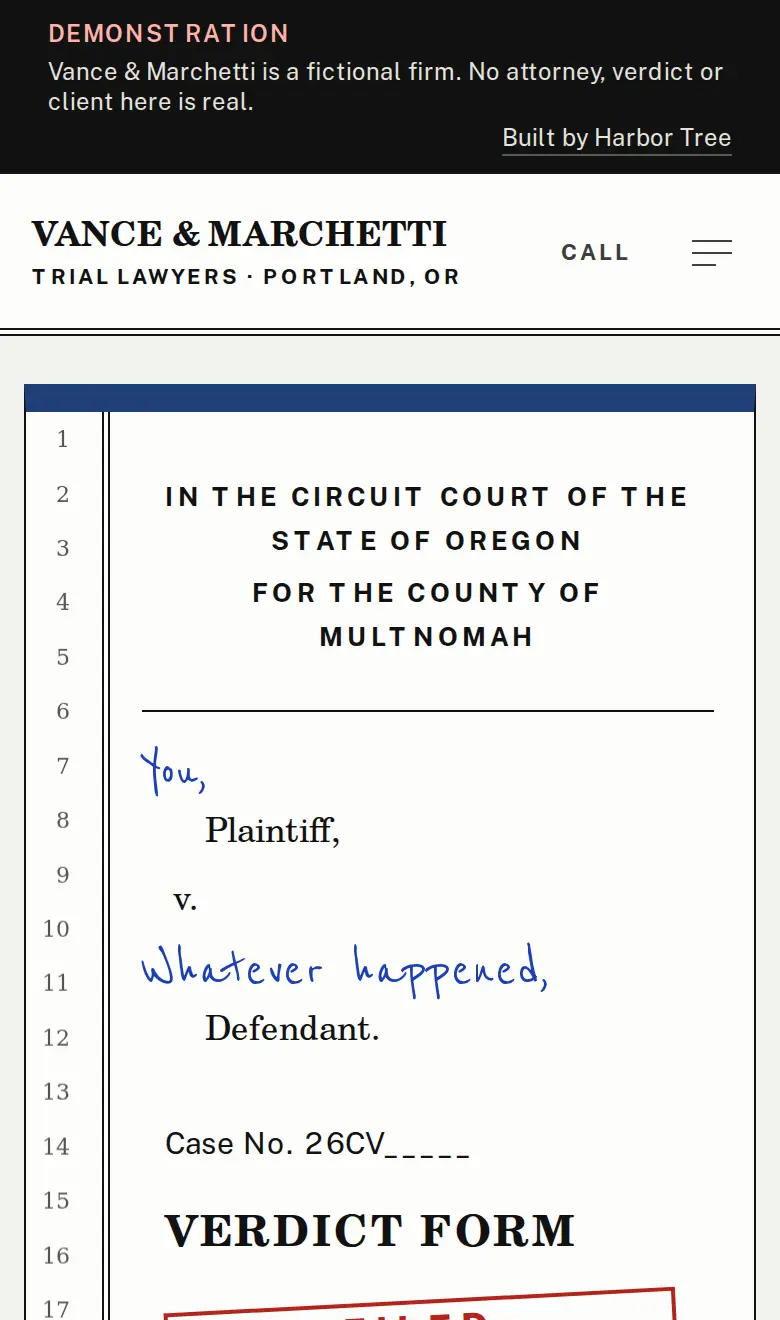
We haven’t been hired by law firms yet. Rather than imply otherwise, we built one: a complete law firm site, every page finished, that you can click through the way one of your customers would.

Vance & Marchetti is invented — the people, the address, the phone number and every figure on it are made up, and the site is kept out of search results on purpose. It is there to be judged as work, not mistaken for a business.

Open the Vance & Marchetti demo (opens in a new tab)

How law firms get chosen

What actually happens before someone calls you

They are searching alone, with nobody they can ask

Legal searches happen alone. Nobody asks a colleague which criminal lawyer to call, or mentions over lunch that they were served divorce papers that morning. The research is private, usually at an odd hour, and usually before anyone else has been told — which means every reassurance the visitor gets has to come off your own pages, because there is nobody they are willing to ask. That is the reverse of how almost every other local service gets chosen.

They hunt for their own situation, written down

What they are scanning for is themselves. Not 'civil litigation' but a construction defect, a non-compete signed four years ago, a second DUI, a guardianship for a parent who has stopped recognizing them. They are hunting for their own situation written down by someone who has plainly seen it before, and a practice list that runs the length of the page reads as a firm that has seen none of them often. A smaller practice with one page written in the visitor's own words beats a larger one with a longer list, routinely.

They read to the end, then go straight to your bio

The reading then runs unusually long. Legal visitors do not skim — the consequence is too large and they are trying to become informed enough not to be taken advantage of. They read the practice-area page to the end, then go straight to the attorney bio, and what they want there is narrow: who exactly will be handling this, and have they handled enough of them. A bio that is a graduation year and a list of bar admissions does not answer it, and it is the last page they were willing to read before picking up the phone.

A referral gets checked twice before anyone dials

Most of this work still arrives by referral — a past client, a doctor, another attorney passing on something outside their practice — but a legal referral gets checked twice. The referring lawyer looks first, because their own reputation travels with the recommendation, and the client looks afterwards, before dialing. Neither is really being persuaded by the site so much as permitted by it. Its job is not to win the matter; it is to be the thing that gives nobody a reason to hesitate.

Where these sites lose the job

Three things most law firms’ sites get wrong

Fourteen practice areas, each a two-sentence stub

The Areas of Practice page is a bulleted list, and every item that is linked at all resolves to ninety words of description that would fit any firm in the state. A visitor with a specific matter reads that as a firm which takes anything, and a firm which takes anything is a firm that specializes in nothing.

A bio that lists admissions and answers nothing

Law school, graduation year, bar admissions, two association memberships. Nowhere on it is how many matters like this one the attorney has handled, which courts they actually appear in, or a photograph — which are the three things somebody deciding whether to hand over their situation came to that page for.

A contact form that asks everything and promises nothing

Six fields, one of them a box headed 'tell us about your case', and not a word about who reads it, how quickly, or whether it is held in confidence. Someone is being asked to type the worst week of their life into a stranger's website on nothing but trust.

What we’d build instead

What a law firm site has to do

  • A page per matter, written in the client's words

    Somebody searching 'wrongful termination' is not searching 'employment litigation'. A page in the language of the person with the problem rather than the language of the pleadings is what gets found, and what convinces once it is.

  • Attorney bios that answer 'have you handled mine before'

    Clients retain a person, not a letterhead. Years spent on this specific kind of matter, the courts you genuinely appear in and a photograph carry far more weight than any list of admissions and association memberships.

  • Fee structure stated as structure, not figures

    Fear of an open-ended bill is what stops the call being made. Saying whether a matter runs on contingency, hourly or flat, and whether the first conversation costs anything, settles it without publishing a number that would be wrong for most matters.

  • A contact path that says who reads it and how fast

    The visitor is being asked to describe a private, unresolved situation to a stranger. Naming who receives it, how quickly they respond and that it stays in confidence is what gets the form finished instead of abandoned halfway.

  • Sensitive practice pages kept clear of third-party trackers

    Someone researching a divorce or a criminal charge is often on a shared or borrowed device and would rather it went no further. Keeping advertising pixels and session recorders off those pages is a build decision, not a privacy-policy paragraph.

Paired with a build

Which services do Maryland law firms pair with a new website?

The pages that win legal work are the ones nobody at the firm has billable time to write, so what gets added here is mostly about getting them written and getting them found.

  • $449 one-time

    Copywriting

    A practice-area page has to be written in the client's words rather than the language of the pleadings, and every hour spent drafting it is an hour not billed. One working call and two rounds is how the page gets written at all.

    Included with Growth and Signature.

    See the add-on menu
  • $225 per page

    Extra page

    One page for each matter you actually take, and one for each attorney. A referred client arrives searching the attorney's name rather than the firm's, and a single Our Team paragraph loses that search outright.

    See the add-on menu
  • $199 a month

    Care Plus

    Legal is the most contested local search there is, and the firms above you publish constantly. A page each quarter, on top of the technical upkeep, is what keeps a small firm from sliding quietly down the results.

    What Care Plus covers

Already have a site? The Website Audit is $375 — a written verdict on whether it is worth improving, worth replacing or already fine, and the fee comes off whatever you do next. How the audit works

Not ready for either? Check your Google listing against your site — free, about ten seconds.

What it costs is the same whatever you do.

We price the build, not the industry — the same site costs the same whoever it is for. What each package includes sits on the websites page; what the market charges, and the terms we work on, sit on the pricing page.

Questions from law firms

The ones we get asked most

Can we publish case results? Our state bar has rules about it.

In almost every jurisdiction yes, provided the required disclaimer travels with them.

Keep the language descriptive rather than superlative: 'best' and 'expert' are where firms get into difficulty far more often than the outcomes themselves.

We build the results section so the disclaimer is structural rather than something a later edit can quietly strip. Your bar is the authority on your rules; the site is built to hold whatever they turn out to be.

Nearly all our work is referred by other attorneys. What is the site for?

It is what makes the referral easy to make.

A lawyer passing on a matter outside their own practice is staking their reputation on you. What they need to see is a page showing you handle that exact kind of matter — not that you are generally competent.

The client then checks you again before dialing. Two people vet the site before anyone calls, and only one of them is your prospect.

We can't name clients or publish testimonials. What proof can the site actually show?

More than most firms use.

Client voices are one kind of proof, and in criminal, family or immigration work they were never going to be available anyway. What is available:

  • the courts and tribunals you genuinely appear in
  • published decisions carrying your name
  • roughly how much of a given matter type you handle in a year
  • what you have written or taught in the area
  • matter descriptions with nothing identifying left in them

None of that needs anybody's permission, and the last one persuades harder than a five-star sentence from a stranger.

Do we need individual attorney pages, or can it stay firm-level?

Individual pages, always.

A client is deciding about a specific person, and a referred client arrives searching the attorney's name rather than the firm's — so a single 'Our Team' paragraph loses that search outright and answers neither visitor.

Named pages are also the only place to put the thing that actually settles it: how often this particular attorney has handled this particular kind of matter.

Still holding a question this did not answer? The full FAQ covers what a build costs, how long it takes and what happens after launch — or write to us and you will get a plain-language answer from the person who would build it.

Start a project

Ready for a site
that wins the job?

Tell us what you're working with. You'll get a plain-language reply — and if we're not the right fit, we'll say so and point you somewhere good.

Don't like the first design? Take your money back. What it covers

Want the number first? Build an estimate — a minute, and no email needed.

Not ready? Check your Google listing — free, about ten seconds.

Prefer email? contact@theharbortree.com

Tell us what you need

Three fields. Takes about thirty seconds.

No newsletters, no spam — your details go straight to us and nowhere else.