Skip to content
Harbor Tree

Websites for landscapers

Website design for landscaping & lawn care.

A yard is the one purchase the whole street gets to grade. And the season is sold months before anything grows.

Fixed price from $1,900 · 3–6 weeks · you own it outright

The short version

What your site has to do

  • Jobs photographed twice, a season apart
  • The maintenance plan written out line by line
  • Pages that know what month it is

See all 5 and why each one matters for landscapers.

Builds start at
$1,900
Typical turnaround
3–6 weeks
Who owns it
You do, outright

Already have a site? See what a machine makes of it.

The site you last looked at in June is being read in February by someone who needs to know you are still trading and how to reach you. Our free check reads one page the way a search engine and a screen reader do, and tells you plainly what it found — about ten seconds, no account, and no email needed to see the results.

Proof

A finished site you can click through

Demonstration build

Wismer Landscape

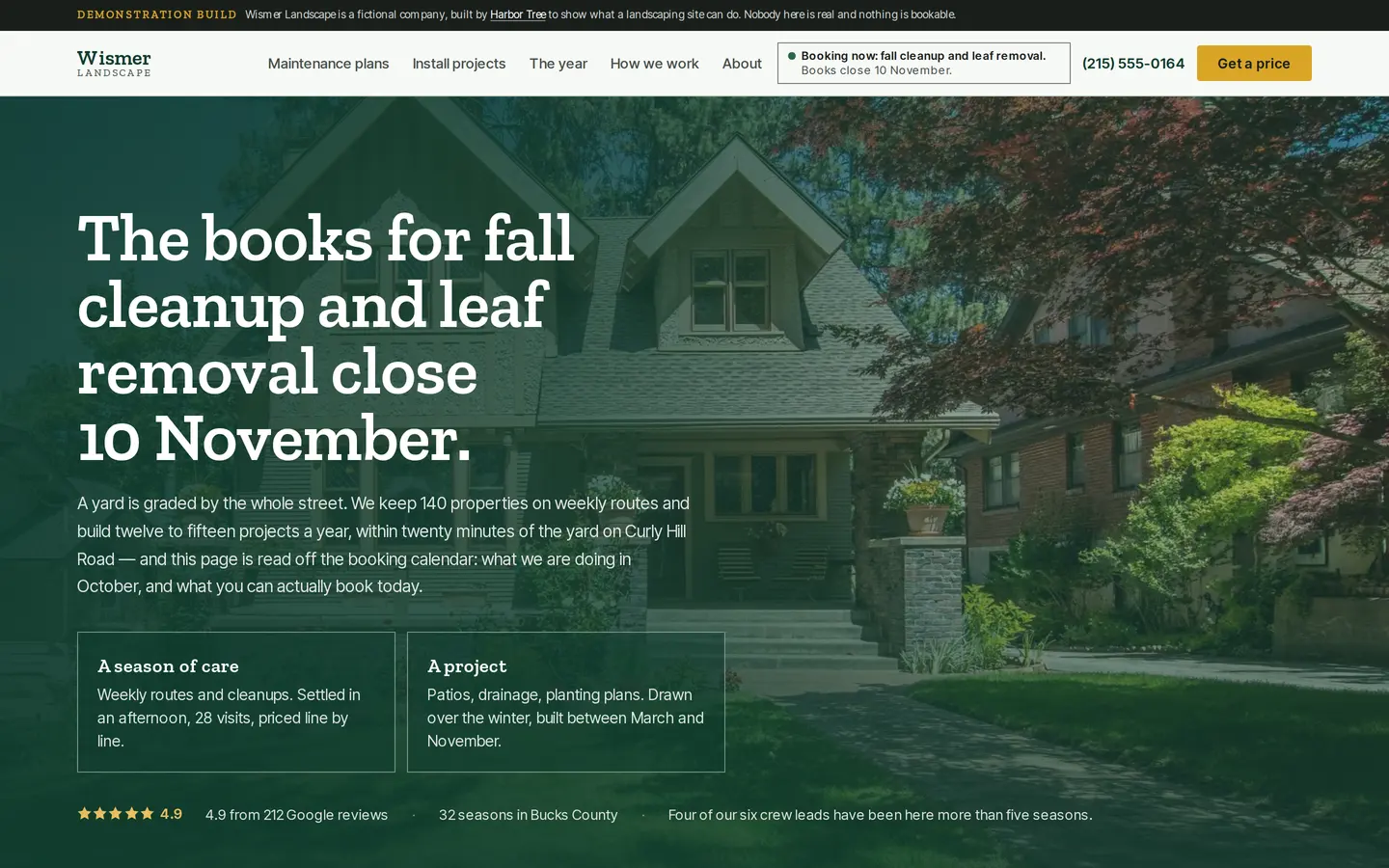
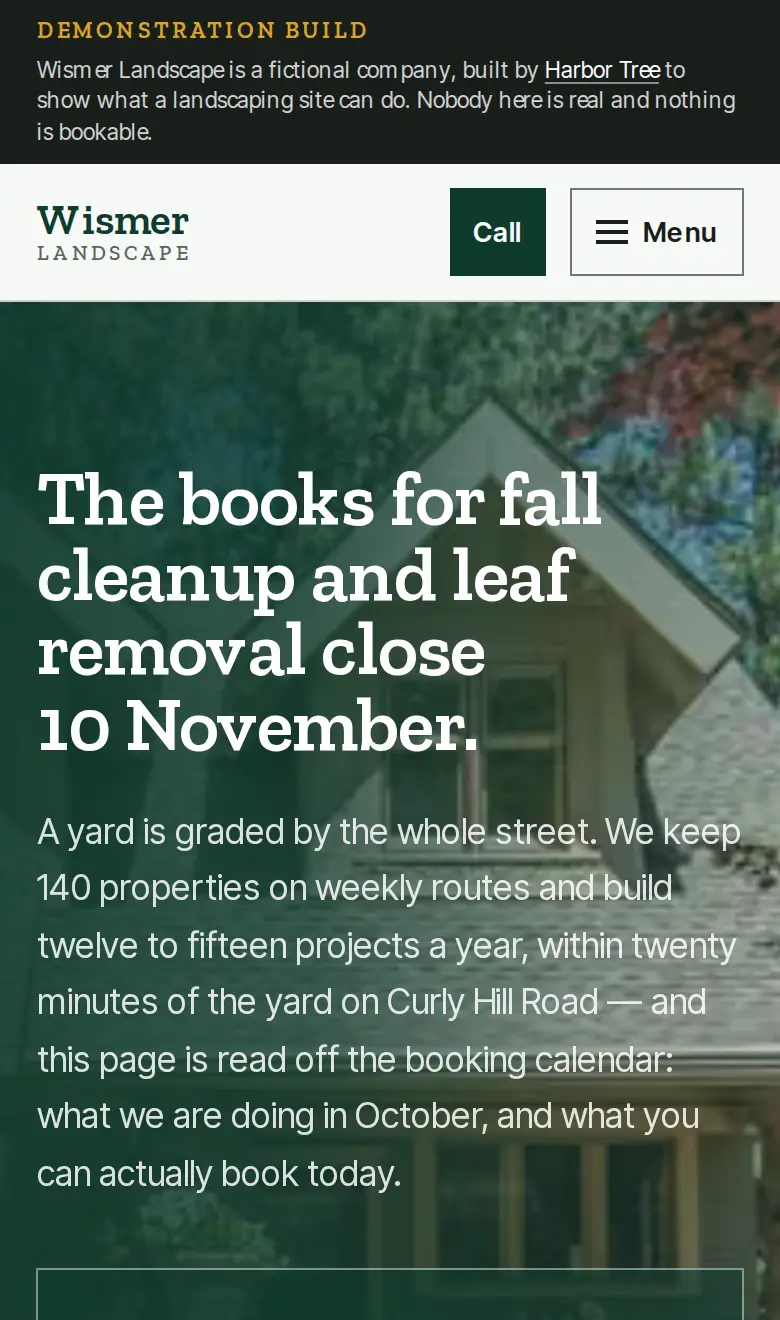
We haven’t been hired by landscapers yet. Rather than imply otherwise, we built one: a complete landscaping company site, every page finished, that you can click through the way one of your customers would.

Wismer Landscape is invented — the people, the address, the phone number and every figure on it are made up, and the site is kept out of search results on purpose. It is there to be judged as work, not mistaken for a business.

Open the Wismer Landscape demo (opens in a new tab)

How landscapers get chosen

What actually happens before someone calls you

You have to be visible before the wave breaks

Very little about this business happens evenly. Demand arrives in two hard waves — the first warm weekend, and the week the leaves come down — and the companies that get picked are the ones already visible when a wave breaks, not the ones that become visible because of it. A route filled by mid-spring is a route for the whole season; a company found in July is covering somebody else's dropped stops. And the four months when nothing grows are exactly when the bigger installs get drawn and decided, so the site is doing its most valuable selling in the months its owner assumes nobody is reading.

Two different buyers share the same driveway

Two quite different purchases share the same driveway. One is recurring: a season of mowing, edging and cleanups, settled in an afternoon, judged almost entirely on whether the crew keeps turning up and what precisely is covered. The other is a project — a patio, a drainage fix, a planting plan — weighed for weeks against two other companies, with a drawing, a deposit and a start date attached. Neither buyer is served by a page that lists both as bullets under Services, because they are not buying the same thing and they are not buying on the same clock.
They already inspected your work three doors down

What makes the choosing unusual is that the work goes on public display and the buyer knows it. A yard is the part of a property the street, the neighbors and in a lot of places an association committee all hold opinions about, so a homeowner who has watched a crew work three doors down arrives at your site having already inspected the product at full size. That inverts the usual sequence, and it changes what the site is for: not introducing the work, but confirming that what they walked past was yours, that it still looks like that a year later, and that whoever did it can be reached.

Most people searching in April are firing somebody

A great many of the people searching in April are firing somebody. Almost never over price — over a crew that skipped a week without saying so, a fall cleanup nobody ever scheduled, edging that was part of the deal in one person's memory and not the other's. So the visitor is reading for evidence of reliability, which is the one quality no amount of saying so ever establishes. What is covered and what is not, which months the plan runs, what happens after a week of rain, and who a homeowner actually reaches when the truck does not appear all read as a company that has had this argument before and written the answer down.

Where these sites lose the job

Three things most landscapers’ sites get wrong

Every photograph taken the day the crew left

Fresh mulch, cut stripes, sod seams still visible. Not one image is the same property in its second summer, which is the only thing a maintenance buyer wants settled: does it hold up across a season you are being paid to be there for, or only on the afternoon of the photograph?

A site that reads the same in February as in June

The homepage is still pushing spring cleanup in October, nothing says when next season's schedule opens or when it stops taking names, and there is no answer anywhere for a visitor asking what you do between November and March. The one trade whose year has a shape publishes a site with none.

A maintenance plan that stops at the word mowing

The plan is named and then described in a single line, leaving whether edging, bed weeding, blowing off the walk, fertilizer, aeration and the fall cleanup are inside it or billed separately to be discovered later. Two companies described this way cannot be compared at all, so they get compared on price.

What we’d build instead

What a landscaping company site has to do

  • Jobs photographed twice, a season apart

    A before-and-after proves you can install. The pair that sells a season is day one beside the following July, because growing in is most of the product and no single photograph can make that claim.

  • The maintenance plan written out line by line

    Every task, how often it happens, the months it runs, and what is deliberately left out. A recurring sale is won on comparability, and whoever is weighing you up is holding a rival's plan that itemizes everything yours left implied.

  • Pages that know what month it is

    When the schedule opens, what is being booked right now, and what happens between November and March. This is the trade whose visitors routinely arrive wanting something that will not exist for another four months, and they need telling what to do in the meantime.

  • Install work published as projects rather than photographs

    A design buyer is committing to something they cannot see until it is built. The problem that started it — a slope, standing water, no privacy — the drawing, the phases and how long each one took is the closest a page can get to letting them walk around in it first.

  • Property access answered before anybody has to ask

    This is the trade that turns up at an empty house every week. Whether the gate code is needed, whether the dog can be out, whether the same crew comes back and who to call when something is wrong are all decisions about giving a stranger repeated access.

Paired with a build

Which services do Maryland landscapers pair with a new website?

A landscaping site has to know what month it is, and it has to keep selling through the four when nothing grows. These are the three that do that.

  • $99 a month

    Care

    This is the one trade whose year has a shape, and a homepage still pushing spring cleanup in October is the failure everybody makes. Care is how the site swings with the season instead of freezing in whichever month it launched.

    What Care covers
  • $225 per page

    Extra page

    Install work sells as projects rather than photographs — the slope, the standing water, the drawing, the phases, the finished thing a year on. Each earns its own page, and each keeps selling in the months nothing grows.

    See the add-on menu
  • $199 a month

    Care Plus

    Demand arrives in two hard waves, and the companies picked are the ones already visible when a wave breaks. A page written in the quiet months is how you are already there in April rather than arriving after it.

    What Care Plus covers

Already have a site? The Website Audit is $375 — a written verdict on whether it is worth improving, worth replacing or already fine, and the fee comes off whatever you do next. How the audit works

Not ready for either? Check your Google listing against your site — free, about ten seconds.

What it costs is the same whatever you do.

We price the build, not the industry — the same site costs the same whoever it is for. What each package includes sits on the websites page; what the market charges, and the terms we work on, sit on the pricing page.

Questions from landscapers

The ones we get asked most

We want the design work, not more mowing. Won't a bigger site just bring more mowing?

A site brings whatever it was built to be found for.

If the only thing described in any detail is a weekly maintenance plan, weekly maintenance is what arrives, and no amount of general polish shifts that.

Install work has to be published as work — the problem, the drawing, the phases, the finished thing a year on. That is what the person planning a patio in February is reading.

The mowing routes are still worth having: they are the base load that pays for the season the design work happens in.

Nobody is searching for a landscaper in February. Is the site just dead for four months?

February is when the following season is decided.

The homeowner who spent winter staring at a yard they are tired of is the one who signs early, and an install breaking ground in April is being drawn now.

What actually kills a site over winter is not the season. It is a homepage still advertising spring cleanup in November, giving a February visitor nothing to do.

A page that says when the schedule opens, and will take a booking for a date that has not arrived yet, turns the quiet months into next year's route.

We do fertilizer and weed control. What can the site say about that?

Describe the program the way a homeowner experiences it:

  • what goes down
  • roughly when in the year
  • how many visits it is
  • what to do about pets and children on the day

What you may claim about a product, and which license numbers have to appear where, is set by your state's pesticide regulatory agency and by applicator licensing — not by a web studio, and we are not going to guess at it on your behalf.

Send us the wording those rules demand and it goes on the page as written.

Our crews are seasonal and turn over. Should any of them be on the site?

Not as individual profiles.

A homeowner is not picking a person here, and a wall of faces that changes every March ages badly and quietly dates everything around it.

What they are really asking is whether the same crew comes back each week, and whether one identifiable human answers when something goes wrong.

So name that person, say how stable the crews are, and leave the seasonal hires off. The exception is whoever designs install work — that is somebody a client will spend a season talking to.

Still holding a question this did not answer? The full FAQ covers what a build costs, how long it takes and what happens after launch — or write to us and you will get a plain-language answer from the person who would build it.

Start a project

Ready for a site
that wins the job?

Tell us what you're working with. You'll get a plain-language reply — and if we're not the right fit, we'll say so and point you somewhere good.

Don't like the first design? Take your money back. What it covers

Want the number first? Build an estimate — a minute, and no email needed.

Not ready? Check your Google listing — free, about ten seconds.

Prefer email? contact@theharbortree.com

Tell us what you need

Three fields. Takes about thirty seconds.

No newsletters, no spam — your details go straight to us and nowhere else.