Skip to content
Harbor Tree

Websites for contractors

Website design for contractors.

A homeowner planning work opens five tabs and asks three companies to quote. This is about being one of the three.

Fixed price from $1,900 · 3–6 weeks · you own it outright

The short version

What your site has to do

  • Galleries organized by job type
  • Credentials above the fold
  • A named service area

See all 6 and why each one matters for contractors.

Builds start at
$1,900
Typical turnaround
3–6 weeks
Who owns it
You do, outright

Already have a site? See what a machine makes of it.

A homeowner weighing you against two other open tabs is usually doing it on a phone, standing in the room they want changed. Our free check reads one page the way a search engine and a screen reader do, and tells you plainly what it found — about ten seconds, no account, and no email needed to see the results.

Proof

Work like this, measured

Residential construction & siding

MJH Construction

A 30-year Eastern-Shore builder whose homepage scored 59 on Google's mobile speed test. We rebuilt it to arrive in a fraction of the bytes, to actually ask for the job — and, as you scroll, to raise one of their own houses from block to finished kitchen.

Read the MJH Construction case study

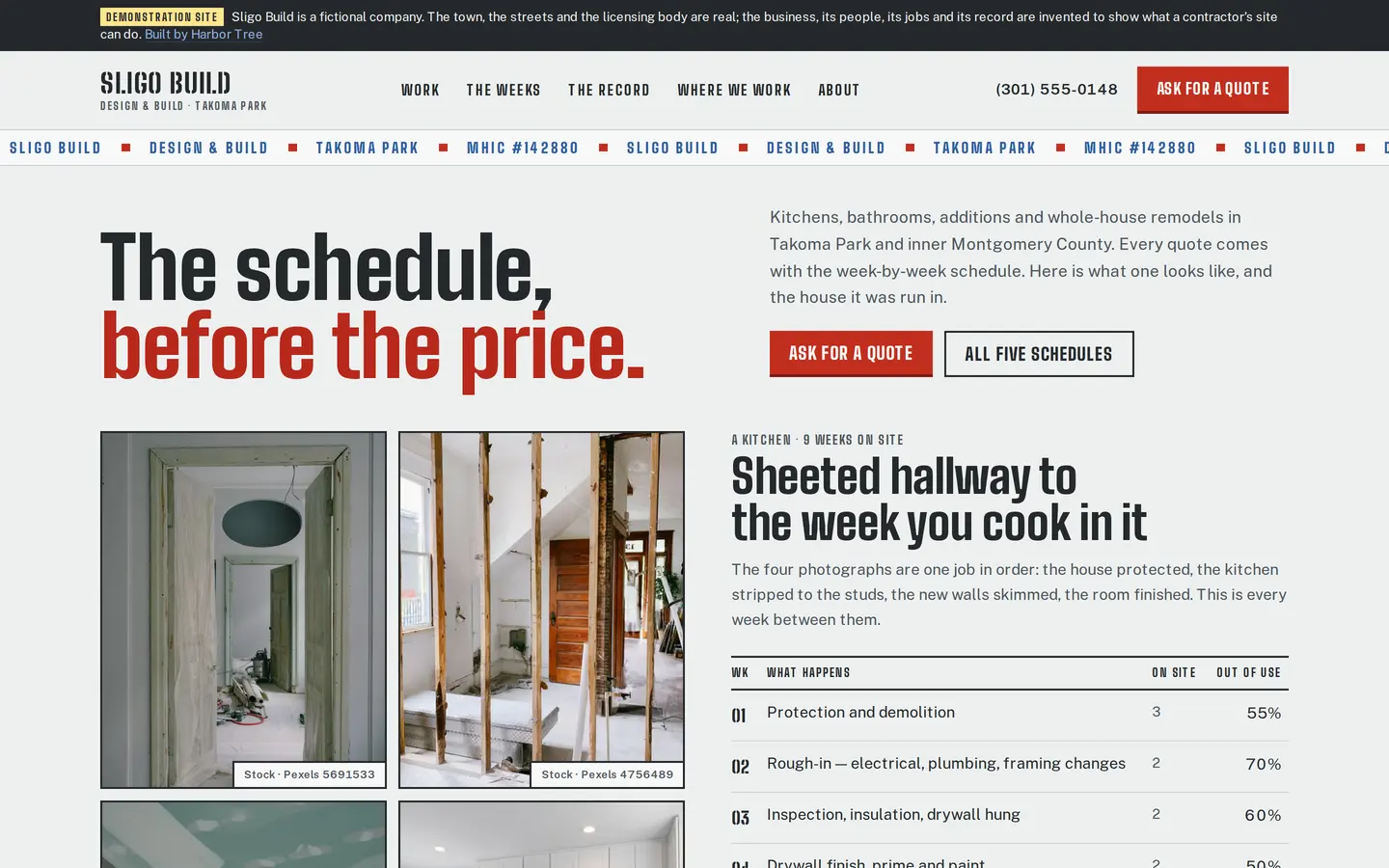
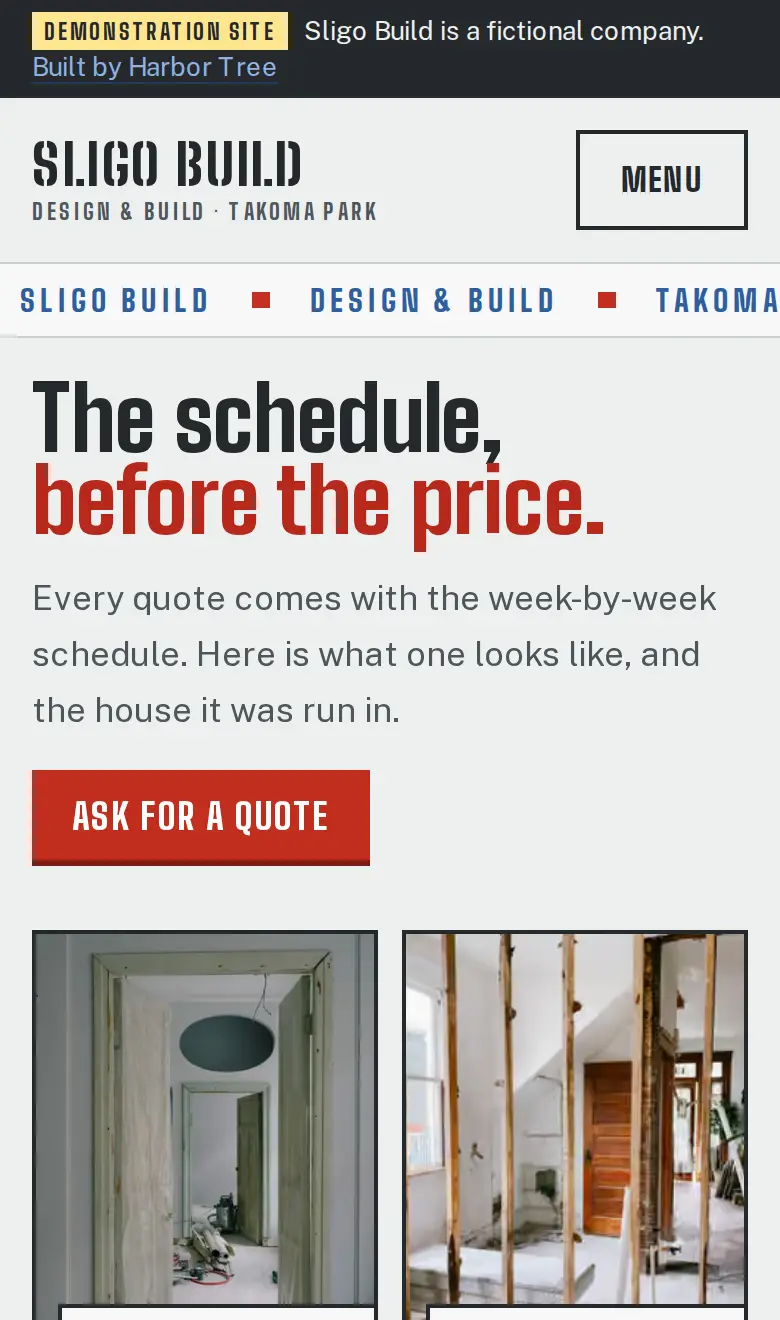
We also built a complete contractor site from scratch to show the thinking in full — Sligo Build is invented, and every page of it is real.

How contractors get chosen

What actually happens before someone calls you

They open five tabs and give each one twenty seconds

Almost nobody hires a contractor from a single search. A homeowner with a project opens four or five tabs in one sitting, skims each one for about twenty seconds, and closes the ones that do not immediately look like they do this kind of work. What is left becomes the shortlist, and the shortlist is usually three. Everything that happens afterwards — the calls, the site visits, the quotes — happens only to companies that survived that first sitting.

Then they take weeks, and come back with a partner

The decision itself is slow. Weeks, sometimes a couple of months, because the money is significant and the disruption is real. During that time the homeowner comes back to your site more than once, often to show a partner, and often to re-check something specific: whether you are licensed, whether you actually cover their town, whether you have done a job that looks like theirs. A site that answered those questions the first time gets shown to the partner. One that did not gets closed again.

What they are really pricing is the job stalling

There is a second thing being decided that the quote conversation never quite covers. A remodel is not a visit — it is strangers in the house every weekday for weeks, and a kitchen out of action for a stretch nobody has yet put a number on. What sits under most of it is not the price; it is the job stalling: a crew that comes for four days, disappears to somebody else's emergency, and leaves a half-finished room behind. Homeowners raise it obliquely, as 'how long will it take', and a site that describes how the weeks actually run is answering the question underneath the one being typed.

The quote closes the job; the site gets you in the room

Put the three together and a contractor's website stops looking like a closing tool. The quote conversation closes the job; the website decides whether you are in the room for it — by surviving the first sitting, holding up when the homeowner comes back with a partner, and settling the thing they are uneasy about but have not asked out loud. That is a narrower and far more specific job than 'looking professional', and it is graded against two other companies open in adjacent tabs.

Where these sites lose the job

Three things most contractors’ sites get wrong

A gallery that never shows their job

Eight or ten photos in one undifferentiated grid, uncaptioned, mixing a kitchen with a roof with a deck. A homeowner planning a bathroom cannot tell whether you have ever done a bathroom, so they assume not and move on. The work is there; the answer to their question is not.

Licensing buried three clicks down

License number and insurance status are among the first things a homeowner checks before letting a stranger into their house, and they are routinely stranded on an About page nobody opens, or left off entirely. Absent, it reads as something being hidden rather than something not mentioned.

No stated service area

The site never names the towns or counties covered, so a visitor forty minutes away cannot tell whether calling is worth it. Very few will call to find out — they will pick whichever of their other two tabs said so plainly, and you never learn the inquiry existed.

What we’d build instead

What a contractor site has to do

  • Galleries organized by job type

    So a visitor planning a bathroom sees bathrooms in one click. Sorting by job answers the only question the gallery is being asked; sorting by date answers a question nobody has.

  • Credentials above the fold

    License number, insurance status and years in business, visible without scrolling. These are checked early and decide whether the rest of the page gets read at all.

  • A named service area

    The towns and counties you actually cover, written out. It removes the single most common reason a qualified visitor closes the tab without contacting anyone.

  • How the job runs while you are in the house

    How many jobs you carry at once, who is on site on an ordinary day, what happens when a material is back-ordered, and how the house gets left each evening. Disruption is the part nobody quotes on and every homeowner is quietly pricing anyway.

  • A quote form that asks what you need to price

    Job type, rough scope, timeframe and property location — so the first reply can be useful instead of being four questions you already knew you would have to ask.

  • Pages that load on a phone in a driveway

    A large share of this traffic arrives on mobile data with the visitor standing in the space they want changed. A gallery-heavy site that takes eight seconds loses them before it renders.

Paired with a build

Which services do Maryland contractors pair with a new website?

Almost every contractor who adds something to a build adds it for the same reason: the site has to be found for a job type in a town, not for a company name.

  • $225 per page

    Extra page

    One page for each job you want to be asked about, and one for each town you will actually drive to. A homeowner searching for a kitchen remodel in their own town is not searching for “remodeling services”, and a single Services page cannot be found by both.

    See the add-on menu
  • $449 one-time

    Copywriting

    You are on a job site all day, which is why the words never get sent over. Drafting them from one working call is usually the difference between a site that launches in five weeks and one that sits at ninety percent until spring.

    Included with Growth and Signature.

    See the add-on menu
  • $199 a month

    Care Plus

    A homeowner comes back to your site more than once across a month of deciding, and arrives from a different search each time. The page written each quarter is another job type, or another town, that you can be found by.

    What Care Plus covers

Already have a site? The Website Audit is $375 — a written verdict on whether it is worth improving, worth replacing or already fine, and the fee comes off whatever you do next. How the audit works

Not ready for either? Check your Google listing against your site — free, about ten seconds.

What it costs is the same whatever you do.

We price the build, not the industry — the same site costs the same whoever it is for. What each package includes sits on the websites page; what the market charges, and the terms we work on, sit on the pricing page.

Questions from contractors

The ones we get asked most

I get most of my work by referral. Do I even need a site?

Yes — the referral checks you online before they call.

Someone handed your name is deciding whether the recommendation holds up, and an absent or dated site quietly undercuts the person who vouched for you.

With a referral the site's job is not to find them. It is to confirm what they were told.

Do the project photos need to be professionally shot?

No — and professional shots are often worse.

A homeowner is looking for their own job in your photos, not admiring the composition. What works:

  • clean, well-lit phone photos of jobs you actually finished
  • captioned with what the work was
  • genuinely yours, and genuinely recent
How long does a contractor site take to build?

Turnaround by tier is listed on the pricing page — the build is rarely the long pole.

What sets the real date is the package and how fast two things come back from you:

  • project photos
  • license and insurance details

The discovery call gives you a date rather than a range, once we have seen what exists.

Most of our electrical and plumbing goes to subs. Do we say that, or present as one company?

Present as one company — but say the subs are there.

A single point of accountability is a large part of what a homeowner is buying, and they find out anyway on the morning an unfamiliar van parks outside. The version that works is short and specific:

  • electrical, plumbing and tile go to licensed specialists
  • they are the people you have worked with for years, not whoever bid lowest
  • the schedule and the standards stay yours either way

Written down, it reads as a company organized around the work. Left out, it reads as something the homeowner had to discover.

Still holding a question this did not answer? The full FAQ covers what a build costs, how long it takes and what happens after launch — or write to us and you will get a plain-language answer from the person who would build it.

Start a project

Ready for a site
that wins the job?

Tell us what you're working with. You'll get a plain-language reply — and if we're not the right fit, we'll say so and point you somewhere good.

Don't like the first design? Take your money back. What it covers

Want the number first? Build an estimate — a minute, and no email needed.

Not ready? Check your Google listing — free, about ten seconds.

Prefer email? contact@theharbortree.com

Tell us what you need

Three fields. Takes about thirty seconds.

No newsletters, no spam — your details go straight to us and nowhere else.