Skip to content
Harbor Tree

Websites for auto repair shops

Website design for auto repair shops.

A light came on Tuesday. The car still drives, so there are a few days in this decision — and one fear running underneath all of them.

Fixed price from $1,900 · 3–6 weeks · you own it outright

The short version

What your site has to do

  • One page per make, naming the equipment behind it
  • The estimate procedure written out step by step
  • A day without the car, planned on the page

See all 5 and why each one matters for auto repair shops.

Builds start at
$1,900
Typical turnaround
3–6 weeks
Who owns it
You do, outright

Already have a site? See what a machine makes of it.

Most of this traffic arrives on a phone at the roadside, where a page that will not adapt or will not dial is the entire story. Our free check reads one page the way a search engine and a screen reader do, and tells you plainly what it found — about ten seconds, no account, and no email needed to see the results.

Proof

A finished site you can click through

Demonstration build

Wilson Bridge Tire & Auto

We haven’t been hired by auto repair shops yet. Rather than imply otherwise, we built one: a complete car repair shop site, every page finished, that you can click through the way one of your customers would.

Wilson Bridge Tire & Auto is invented — the people, the address, the phone number and every figure on it are made up, and the site is kept out of search results on purpose. It is there to be judged as work, not mistaken for a business.

Open the Wilson Bridge Tire & Auto demo (opens in a new tab)

How auto repair shops get chosen

What actually happens before someone calls you

Not urgent — but they have to leave the car with you

Hardly any of this is an emergency. A warning light came on, a noise started last week, the state inspection is due, the scheduled maintenance is overdue, the tires will not see out another winter. The car is still moving, so the driver has days rather than seconds and will spend part of them reading. It also carries the thing that most separates a shop from a trade that comes to you: nobody is coming out to them. They have to bring the car to you, leave it, and then get themselves somewhere else — so what they are choosing is how a working day is going to go, not just who fixes the fault.
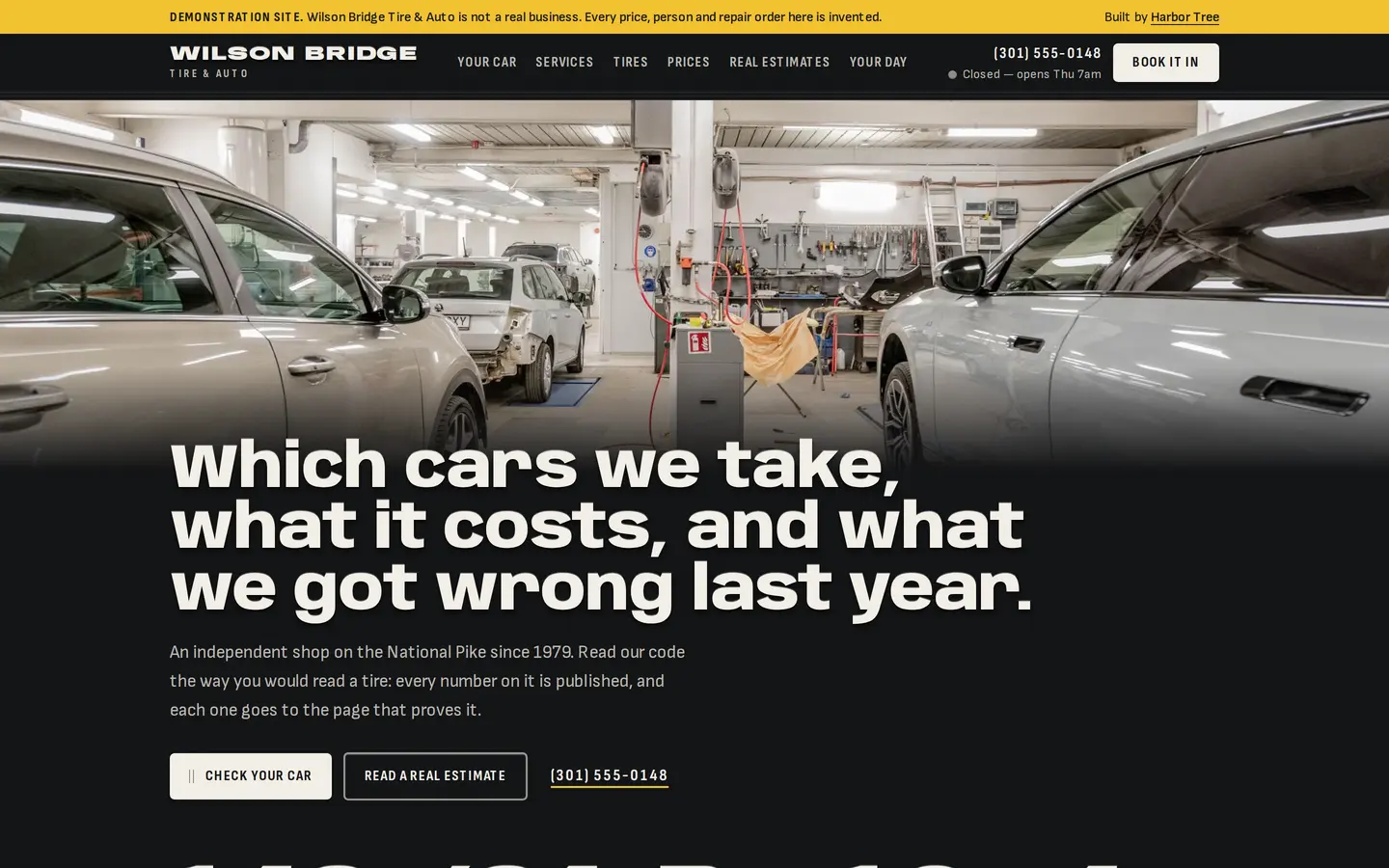
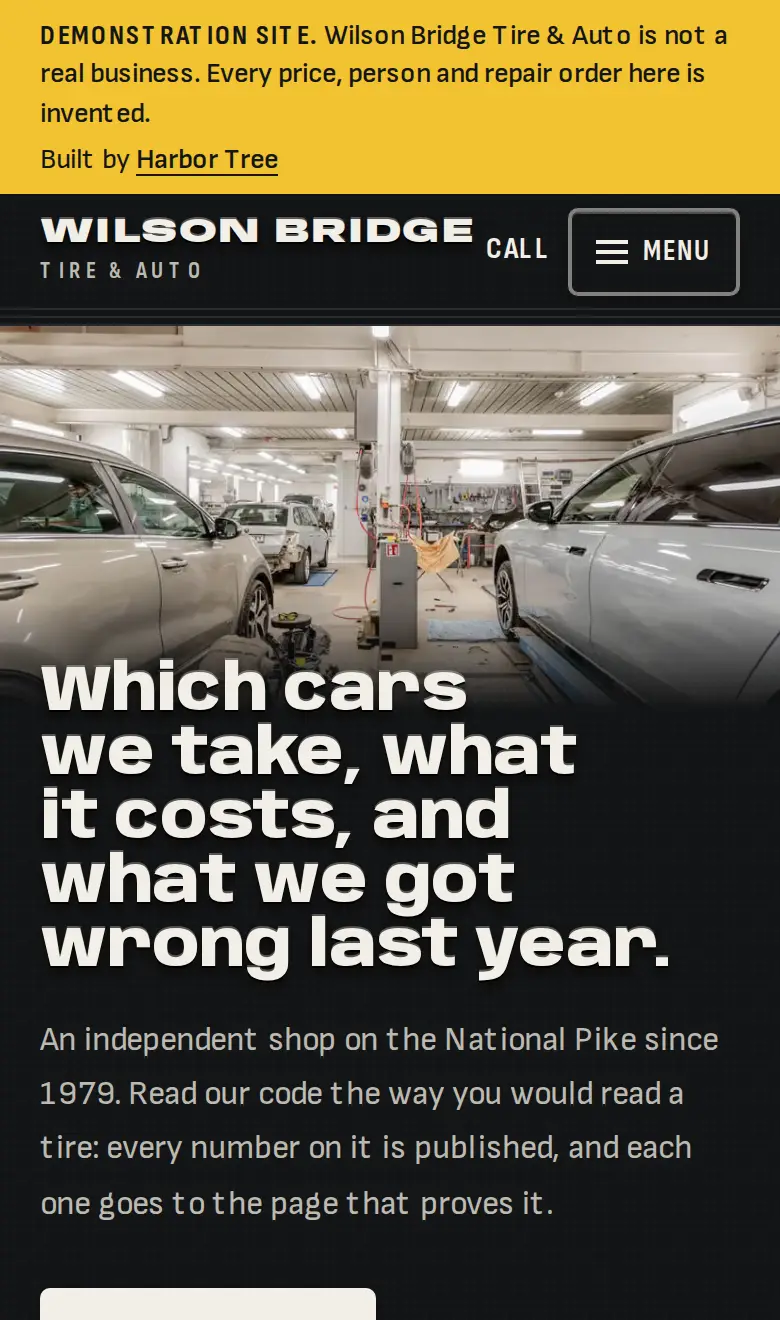
The fear is being sold work that was not needed

The fear underneath the search is unusually specific and close to universal: being sold work that was not needed. Everybody has a story about a shop that found three more things once the car was on the lift, and not repeating that story is the actual brief. It changes how they read everything, reviews included — they open the one- and two-star ones first and read for the moment the bill grew. What a site can do about it is publish the procedure rather than the sentiment: what gets put in writing first, who calls before the job grows, whether the old part comes back in a box.

The eliminating question: do you work on my car

Then there is the eliminating question, and it is one no HVAC tech is ever asked: do you work on my car. A Subaru with a head gasket, a diesel van, a hybrid, a European sedan with a module that needs coding, a pickup heavier than the lift will take — every one of those drivers is scanning for their own vehicle named somewhere on the site. Brakes, oil, suspension and diagnostics names nobody. It is a yes-or-no question, and a site that will not answer it hands the booking to a shop whose site will.

A shop they trust gets kept for a decade

What is being decided is also larger than the repair in front of them. A homeowner hires a contractor for one project and calls a plumber when something bursts; a driver who finds a shop they trust stays for a decade, across two or three cars, and passes the name to their family. So the reading runs further than the job — who owns the place, how long it has been there, whether the same technician sees the car twice, what happens when something you fixed does not stay fixed. A site written to win one repair is aiming at a much smaller thing than the visitor is deciding.

Where these sites lose the job

Three things most auto repair shops’ sites get wrong

A services list that never names a make

Brakes, oil changes, diagnostics, suspension, exhausts — a list that would describe any shop in the country and settles nothing for the drivers worth having. The Subaru owner, the Sprinter owner and the hybrid owner all leave without learning whether you would even take the car.

Nothing about who authorizes extra work

The one fear every driver brings is met with adjectives — honest, reliable, family-owned since 1998. Nowhere does the site state that an estimate is written before anything is touched, that nobody adds to it without a call first, or that old parts come back with the car.

A drop-off policy that exists only on the phone

The site gives an address, opening hours and a number, then stops. Whether you can leave the car at seven, whether there is an overnight key drop, whether anybody can run someone to their office, whether waiting means twenty minutes or most of a day — the site mentions not one of them.

What we’d build instead

What a car repair shop site has to do

  • One page per make, naming the equipment behind it

    A driver is not asking what you can do in general, they are asking whether you touch their car — the scan tool you own, the diesel work, the hybrid training, the lift rating. That is a fitment question about one specific vehicle, and the site has to be able to settle it without a call.

  • The estimate procedure written out step by step

    Every visitor arrives braced to be upsold. Setting out that the job is priced in writing before a wrench turns, that nothing is added without a call and an authorization, and that old parts are available on request answers that fear before anybody dials.

  • A day without the car, planned on the page

    Early drop-off, the key drop, the shuttle or loaner, whether waiting is realistic and roughly how long. This is scheduling information rather than marketing, and it is what decides which of two shops gets Thursday.

  • Tire fitment answered before the call

    Tires are the one thing here bought to an exact specification, and the buyer already knows their size. A shop that cannot confirm what fits, what it stocks and what it can get in by Friday loses to a chain whose website could.

  • A comeback and warranty policy stated in public

    What settles a ten-year relationship is not the first repair but what happens when one does not hold. How long parts and labor are covered, and what a comeback visit actually involves, outweighs any adjective about being trustworthy.

Paired with a build

Which services do Maryland auto repair shops pair with a new website?

Two questions decide a shop — do you work on my car, and will you sell me work I did not need — and both get answered with pages, which is where most of this goes.

  • $225 per page

    Extra page

    One page per make you actually service, naming the scan tool, the diesel work, the hybrid training, the lift rating. “Do you work on my car” is a yes-or-no question, and a services list answers it for nobody.

    See the add-on menu
  • $449 one-time

    Copywriting

    The estimate procedure is the most valuable page on a shop's site and the hardest one to write about yourself. What goes in writing before a wrench turns, who calls before the job grows, whether the old part comes back in a box.

    Included with Growth and Signature.

    See the add-on menu
  • $199 a month

    Care Plus

    Drivers search by make and by symptom, and both shift with what is on the road locally. A page each quarter is how a shop keeps turning up for searches it did not rank for last year.

    What Care Plus covers

Already have a site? The Website Audit is $375 — a written verdict on whether it is worth improving, worth replacing or already fine, and the fee comes off whatever you do next. How the audit works

Not ready for either? Check your Google listing against your site — free, about ten seconds.

What it costs is the same whatever you do.

We price the build, not the industry — the same site costs the same whoever it is for. What each package includes sits on the websites page; what the market charges, and the terms we work on, sit on the pricing page.

Questions from auto repair shops

The ones we get asked most

Should the site say we charge for diagnosis?

Yes, plainly — and say whether it comes off the repair.

Shops lose both ways when it is left unsaid: one driver turns up assuming a free look and the conversation starts badly, another assumes the worst and calls a chain instead.

It is the awkward thing on a shop's site that gets easier the moment it is written down, because a driver who read it in advance has already agreed to it.

The dealer down the road is our real competition. What can a site do about that?

Answer the two things a dealer is assumed to have.

  • Competence on the make. That is what naming the makes, the scan equipment and the training is for.
  • Warranty. A great many drivers believe servicing outside the dealer voids theirs, which federal warranty law generally does not support, and almost no independent shop's site says a word about it.

Where exactly that line falls for a given vehicle is between the manufacturer's terms and your own counsel, not us.

But a page that states your position plainly, and can be corrected in a minute if it changes, wins arguments the price never will.

Do we need online booking?

Not the kind that hands out timed slots.

A repair is a drop-off and a diagnosis, not an appointment of known length, and a calendar promising nine o'clock for an unknown fault sets up a broken promise on day one. What works is a request form carrying:

  • make, model, year and mileage
  • the symptom, in the driver's own words
  • when the car can be left

Enough that the reply can name a real day rather than open a conversation.

Tires are a big part of what we do. Does that need its own section?

It earns one — tire buyers behave nothing like repair customers.

They arrive knowing the exact size, they compare brands rather than shops, and they buy on a date they have already chosen.

They are also how a shop meets drivers who do not yet have a mechanic.

Somebody who came for tires in October is the easiest repair customer you will ever get in March — and only if the tire pages were good enough to bring them in.

Still holding a question this did not answer? The full FAQ covers what a build costs, how long it takes and what happens after launch — or write to us and you will get a plain-language answer from the person who would build it.

Start a project

Ready for a site
that wins the job?

Tell us what you're working with. You'll get a plain-language reply — and if we're not the right fit, we'll say so and point you somewhere good.

Don't like the first design? Take your money back. What it covers

Want the number first? Build an estimate — a minute, and no email needed.

Not ready? Check your Google listing — free, about ten seconds.

Prefer email? contact@theharbortree.com

Tell us what you need

Three fields. Takes about thirty seconds.

No newsletters, no spam — your details go straight to us and nowhere else.