Skip to content
Harbor Tree

Websites for dental practices

Website design for dental practices.

A new patient decides in one sitting: do you take their plan, how far is the drive, and can they book without phoning.

Fixed price from $1,900 · 3–6 weeks · you own it outright

The short version

What your site has to do

  • An insurance page that names carriers
  • Booking that finishes on the page
  • Photographs of your actual rooms and people

See all 5 and why each one matters for dental practices.

Builds start at
$1,900
Typical turnaround
3–6 weeks
Who owns it
You do, outright

Already have a site? See what a machine makes of it.

The gap between a booking button and a number that only opens a dialer is the kind of thing you stop being able to see on your own site. Our free check reads one page the way a search engine and a screen reader do, and tells you plainly what it found — about ten seconds, no account, and no email needed to see the results.

Proof

A finished site you can click through

Demonstration build

Rowan & Bay Dental

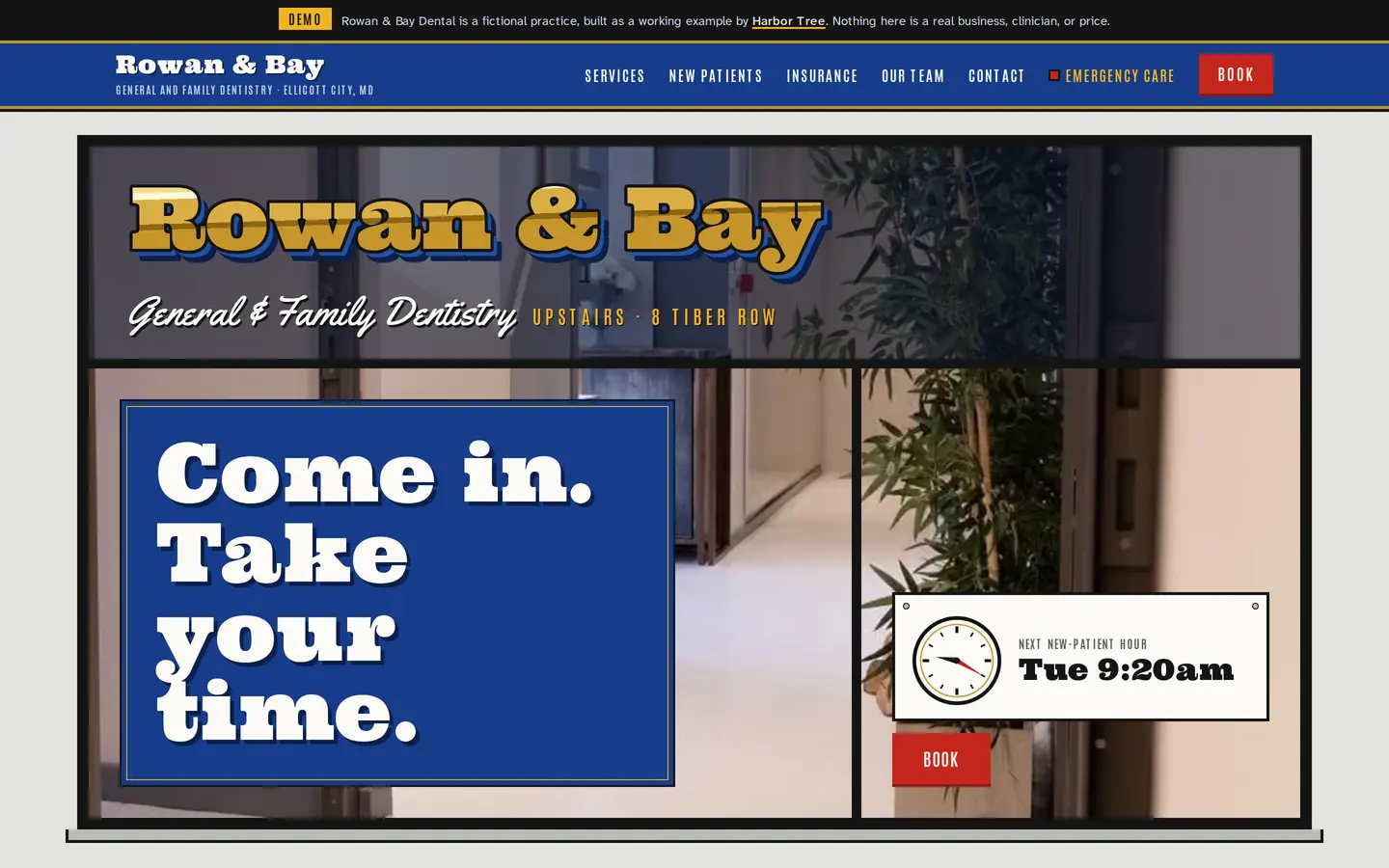
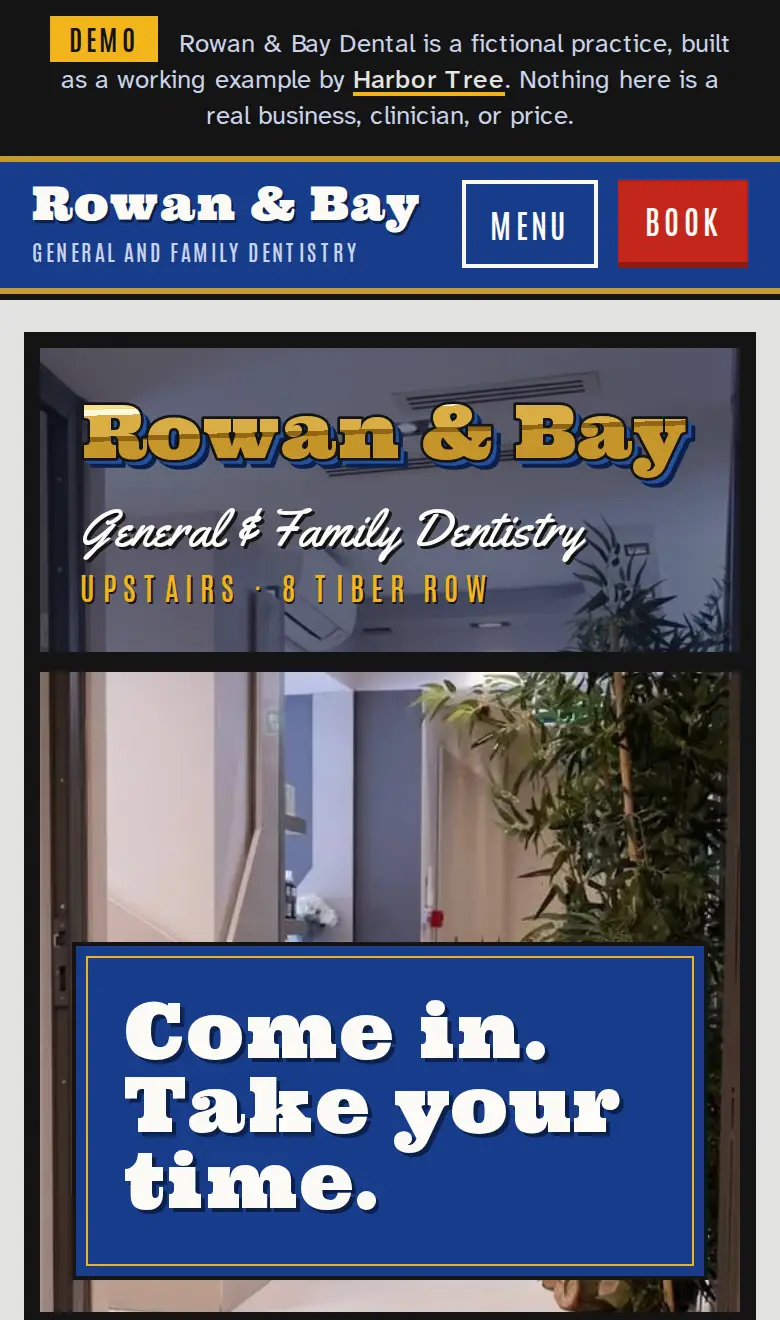
We haven’t been hired by dental practices yet. Rather than imply otherwise, we built one: a complete dental practice site, every page finished, that you can click through the way one of your customers would.

Rowan & Bay Dental is invented — the people, the address, the phone number and every figure on it are made up, and the site is kept out of search results on purpose. It is there to be judged as work, not mistaken for a business.

Open the Rowan & Bay Dental demo (opens in a new tab)

How dental practices get chosen

What actually happens before someone calls you

Plan and location filter you out before a word is read

Nobody browses for a dentist. The search starts because something changed — they moved, they switched jobs and with it their plan, or a tooth started hurting on a Sunday night. That trigger arrives with two hard filters already applied before a word of your copy is read: is this practice close enough to reach on a working day, and does it take the plan I have. Fail either and you are not compared, you are skipped.

You are competing with another week of not booking

The part with no real equivalent in other industries is the delay. A great many adults put off dental care for months, and what they are avoiding is usually not the treatment — it is the phone call, where a stranger asks when they were last seen and they have to say out loud that it has been four years. That is what your website is actually competing against. Not the practice down the road, but another week of not booking.

The whole thing happens at 10pm, or it does not

So a dental site sits somewhere most local business sites never get to sit: it is the transaction, not the shortlist that leads to one. The search, the insurance check and the appointment all happen inside the same ten minutes, very often late in the evening when nobody is answering your phone. If the site names their carrier, shows them the room they will be sitting in and takes the appointment there and then, it has done the entire job. If it hands back a phone number and office hours, it has handed the decision to someone who was already looking for a reason to postpone.
A referral still dies on a failed insurance check

Word of mouth still drives a lot of this — 'who do you see?' asked across an office kitchen — but a recommendation does not survive a failed insurance check. The referred patient looks you up, confirms the plan, and only then books. And they are usually deciding for more than themselves: whether you see children, whether two people can be seen the same morning, whether it is on the way to school. A site written for one adult with one appointment is answering a smaller question than the one being asked.

Where these sites lose the job

Three things most dental practices’ sites get wrong

Insurance answered with 'most plans accepted'

The most-checked fact on any dental site, answered with a four-word non-statement. A visitor holding a Cigna card cannot confirm anything from it, and confirming means phoning — which is exactly what they opened the site to avoid. The practice that listed carriers by name gets the appointment.

A booking button that opens a phone dialer

The page advertises online booking and the button is a tel: link, or a form promising a call back during office hours. Someone who chose you at ten on a Sunday night specifically because they did not want to make a phone call is now being asked to make one tomorrow, after the resolve has worn off.

Stock smiles where the actual room should be

A model laughing at nothing, a gloved hand holding a mirror, a waiting room photographed in a state nobody on your team has visited. The anxious patient is trying to picture sitting in your chair, and every one of those images refuses to help while quietly implying there is a reason the real one is not shown.

What we’d build instead

What a dental practice site has to do

  • An insurance page that names carriers

    Every plan you are in network with, written out in full, plus a plain sentence on what happens when a visitor's plan is not listed. It is the filter applied before anything else on the site is read.

  • Booking that finishes on the page

    Genuine open slots, bookable at ten at night with nobody at the desk, wired into the scheduler your practice already runs. The appointment is won or lost in the same sitting as the search that started it.

  • Photographs of your actual rooms and people

    The operatory, the waiting area, the parking, the faces that will be in the room. What a nervous patient wants is to have already seen the place once before walking into it, and stock photography cannot give them that.

  • A first-visit page that says what happens

    How long it takes, what gets done, what to bring, what it will feel like. Taking the unknown out of the first appointment is the cheapest reduction in anxiety a dental site can perform.

  • A page for each treatment you want to be asked about

    Somebody dreading a root canal, an extraction or a first implant is working out whether you do it here or send them elsewhere, and whether sedation is offered. A line in a Services list settles neither, so they keep looking.

Paired with a build

Which services do Maryland dental practices pair with a new website?

A dental site is the transaction rather than the shortlist, so what gets added to one is usually whatever removes the last reason to phone instead of book.

  • $225 per page

    Extra page

    A page for each treatment you want to be asked about — the root canal, the first implant, whether sedation is offered. A line in a Services list settles none of them, and the patient dreading that exact procedure keeps looking.

    See the add-on menu
  • $199 a month

    Care Plus

    New-patient searches are decided in the results before a word of your copy is read, and the practices above you are publishing. This is the plan that keeps a site findable between rebuilds rather than slowly sinking after one.

    What Care Plus covers
  • $99 a month

    Care

    Your carrier list is the most-checked fact on the site and it moves. Care is what makes a plan added in March appear on the page in March, instead of waiting for whenever the site is next touched.

    What Care covers

Already have a site? The Website Audit is $375 — a written verdict on whether it is worth improving, worth replacing or already fine, and the fee comes off whatever you do next. How the audit works

Not ready for either? Check your Google listing against your site — free, about ten seconds.

What it costs is the same whatever you do.

We price the build, not the industry — the same site costs the same whoever it is for. What each package includes sits on the websites page; what the market charges, and the terms we work on, sit on the pricing page.

Questions from dental practices

The ones we get asked most

Does a dental website need to be HIPAA compliant?

The public pages hold no patient information, so publishing them is not where the risk sits.

It changes the moment a form collects a name and a reason for visiting — so booking is routed into the scheduling system your practice already runs, and nothing is stored on the website.

Whether that system is properly covered is between your compliance officer and your vendor's business associate agreement, not us. What the build can do is make sure the site never becomes a second place you have to ask about.

We're booked out three months. Why would we want more new patients?

Then the site's job is filtering, not volume.

A practice at capacity wants the right new patients, and wants far fewer calls that end in 'sorry, we don't take that plan'. Three things answered in public do that screening before your front desk spends twenty minutes on it:

  • which carriers you take, by name
  • where you are, and how far the drive really is
  • which treatments you actually want to be doing
Our practice-management software includes a website. Isn't that enough?

It is enough to exist. It is not enough to decide anybody.

Those templates are the same handful of layouts running in every zip code, and you usually cannot take the site with you if you leave the vendor. The pages that decide new patients are the ones the template will not let you build:

  • carriers listed by name
  • real photographs of your own rooms
  • a page per treatment

The scheduler is the part worth keeping, and it can be embedded in a site you own outright.

Should we publish our fees?

Usually not — insurance makes almost every published dental figure wrong for the person reading it.

A number that turns out to be wrong costs more trust than no number at all. What patients do want stated in public:

  • which plans you take
  • whether financing is available
  • what a first visit includes

What we charge for the build itself sits on our pricing page.

Still holding a question this did not answer? The full FAQ covers what a build costs, how long it takes and what happens after launch — or write to us and you will get a plain-language answer from the person who would build it.

Start a project

Ready for a site
that wins the job?

Tell us what you're working with. You'll get a plain-language reply — and if we're not the right fit, we'll say so and point you somewhere good.

Don't like the first design? Take your money back. What it covers

Want the number first? Build an estimate — a minute, and no email needed.

Not ready? Check your Google listing — free, about ten seconds.

Prefer email? contact@theharbortree.com

Tell us what you need

Three fields. Takes about thirty seconds.

No newsletters, no spam — your details go straight to us and nowhere else.