Skip to content
Harbor Tree

Websites for fitness studios

Website design for gyms and fitness studios.

The first question is never what it costs. It is whether they will be the least fit person in the room.

Fixed price from $1,900 · 3–6 weeks · you own it outright

The short version

What your site has to do

  • Every class labeled with what it assumes you can already do
  • A trial path with no sales appointment inside it
  • The room shown at the hour they would come

See all 5 and why each one matters for fitness studios.

Builds start at
$1,900
Typical turnaround
3–6 weeks
Who owns it
You do, outright

Already have a site? See what a machine makes of it.

A schedule or a price that reads fine to you inside the building can be unreadable to a search engine and to anyone using assistive technology. Our free check reads one page the way a search engine and a screen reader do, and tells you plainly what it found — about ten seconds, no account, and no email needed to see the results.

Proof

A finished site you can click through

Demonstration build

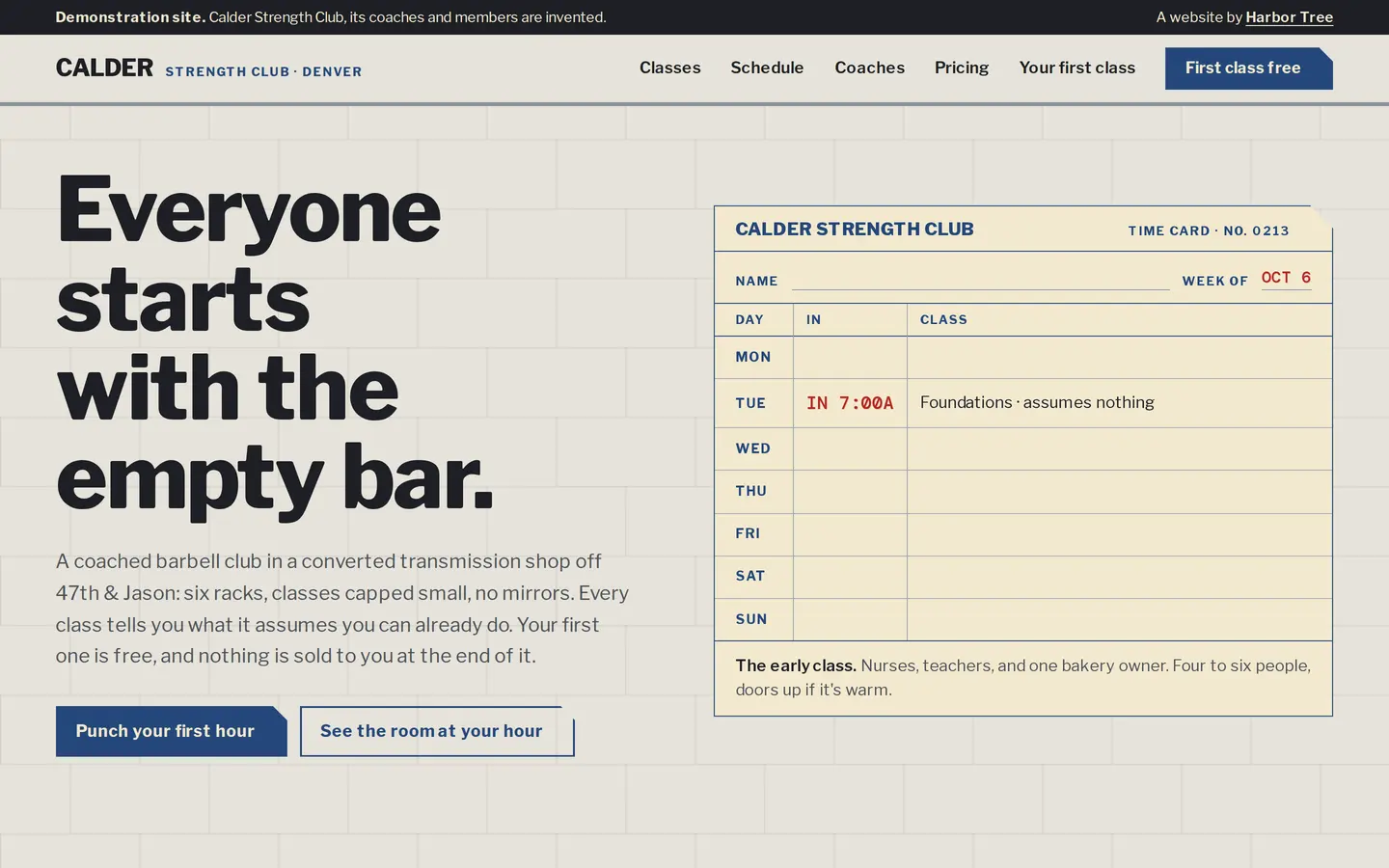
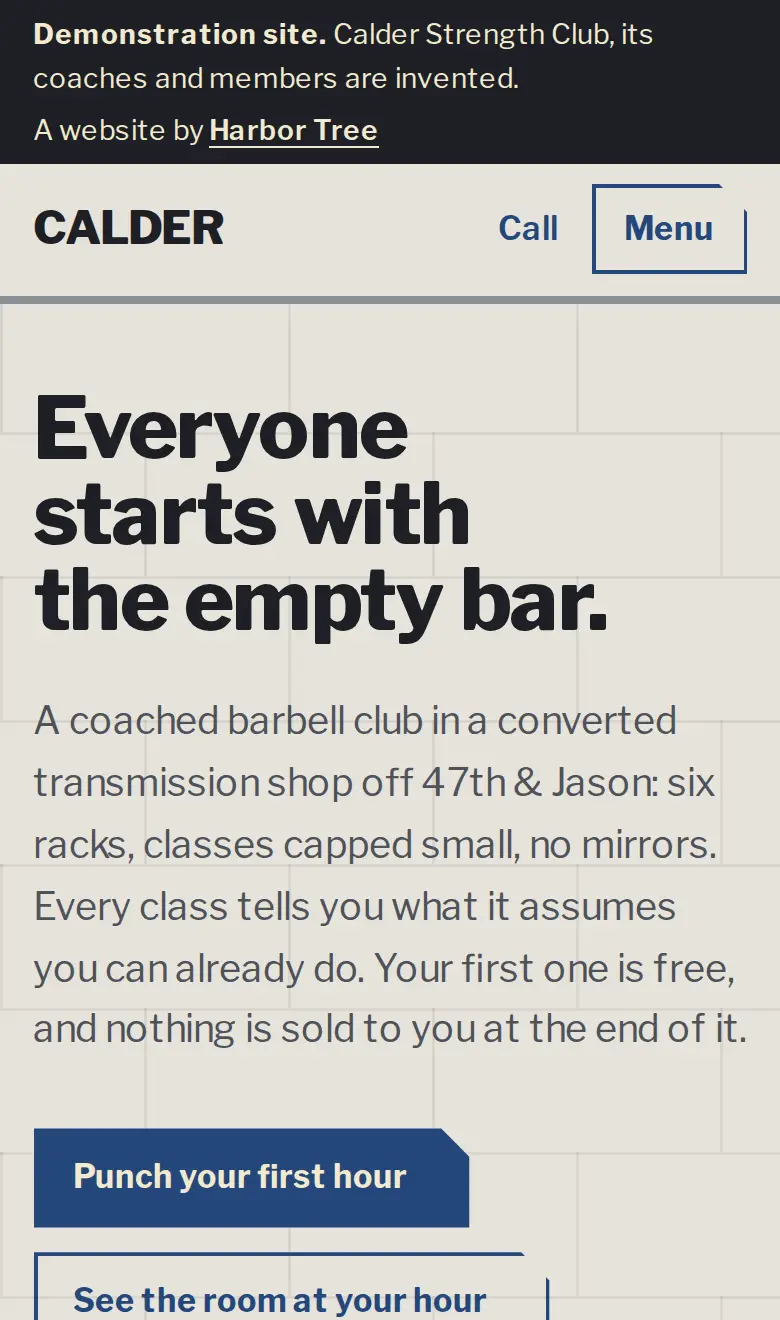
Calder Strength Club

We haven’t been hired by fitness studios yet. Rather than imply otherwise, we built one: a complete fitness studio site, every page finished, that you can click through the way one of your customers would.

Calder Strength Club is invented — the people, the address, the phone number and every figure on it are made up, and the site is kept out of search results on purpose. It is there to be judged as work, not mistaken for a business.

Open the Calder Strength Club demo (opens in a new tab)

How fitness studios get chosen

What actually happens before someone calls you

Weeks pass between deciding and walking in

The decision to start and the act of walking in are separated by weeks. Something prompts it — a photograph, a doctor, a birthday, a knee that has begun complaining — and then comes a long stretch of reading about gyms in the evening and going to none of them. Money is rarely what holds it up, and neither is the schedule. What holds it up is the picture in their head of a room where everybody else already knows what they are doing, and a website is where that picture gets either fixed or confirmed.

They read the photographs for people, not equipment

So they read the site for people rather than equipment. They are studying whoever is in the photographs and asking whether anybody there is their age, their size, their level of not-having-done-this-in-years, and counting how many bodies are in the room at the hour they might realistically come. A gallery of your strongest member mid-lift is honest, deserved and flattering to that member, and to a beginner it reads as a closed door. The equipment list barely registers. The question they arrived with is a social one, and the site answers it whether or not it means to.

The trial is the product, and they fear the pitch

The membership itself is hardly ever the first purchase. What gets bought is a trial — one class, a week, an introductory session — so the trial is the actual thing the site is selling, and every part of it gets inspected before anybody commits to it. The hesitation attached to it is specific and it is not about the exercise: it is the suspicion that saying yes to a free class buys you an hour afterwards in a small office with somebody working through your objections. Saying in public what the trial involves, and what does not happen at the end of it, removes the last obstacle between a decision already made and a door.

Not is it good, but is it for people like me

Underneath all of it sits a match that has nothing to do with quality. A boxing gym, a barre studio, a strength facility with three platforms and a twenty-four-hour access gym are not competing on how good they are; they are competing to be recognized by the person who belongs in one of them. Someone who wants coaching will not last a month somewhere nobody speaks to them, and someone who wants to be left alone will not go back to a room that writes their name on a whiteboard. Copy that would fit any of the four fails the only test being run on it, which is whether this place is for people like me.

Where these sites lose the job

Three things most fitness studios’ sites get wrong

A class schedule nobody outside the building can read

The schedule is a grid of in-house names — Metcon 45, Reformer 2, Flow, Open Gym — with no descriptions, no levels and nothing marking which of them somebody who has not trained in five years could walk into. It says when things happen and nothing about whether any of them is survivable.

A price hidden behind a tour

Membership rates appear nowhere, and every path through the site ends at a form that books a visit with whoever is paid to close. Everybody arrives with a theory about what a withheld price means, none of the theories are flattering, and plenty of them leave rather than agree in advance to be worked on.

A free first class with no instructions attached

The banner offers one on the house and stops there. How to claim it, how early to arrive, what to wear, whether shoes are needed, whether to eat first, what the opening ten minutes involve and what happens when it ends are all missing from the one page a first-timer needs most.

What we’d build instead

What a fitness studio site has to do

  • Every class labeled with what it assumes you can already do

    The question is not what a class is called, it is whether the room will expect something the visitor cannot do yet. Stating the assumed starting point, and what scaling a movement down actually looks like, is what turns a schedule into something bookable.

  • A trial path with no sales appointment inside it

    The trial is the only thing most visitors will ever buy first, and what stops them claiming it is the meeting they assume is attached to it. Saying how it is claimed, what it includes and that nothing gets sold at the end is worth more than making it free.

  • The room shown at the hour they would come

    Six in the morning and six in the evening are different rooms with different people in them. Somebody working out whether they would be conspicuous has to see the class they would actually attend, not the studio's best-looking hour.

  • Membership commitments and the way out, both in public

    The second thing keeping somebody from joining is the fear of being tied in. How long an agreement runs, whether it can be paused, and how it gets canceled belong on the site rather than in a paragraph produced at the desk.

  • Coaches described by how they run a room

    Nobody is picking a coach here. They are working out whether the person who will correct their form in front of strangers is qualified and decent about it, so certifications matter and so does saying how much correcting a first-timer should expect.

Paired with a build

Which services do Maryland fitness studios pair with a new website?

Everything a studio adds is aimed at the same nervous visitor: showing them who the room is for before they have to walk into it.

  • $449 one-time

    Copywriting

    Every class needs describing by what it assumes you can already do, and the trial needs saying out loud that nothing gets sold at the end of it. That is the hardest writing in the trade, and you are coaching all day.

    Included with Growth and Signature.

    See the add-on menu
  • $225 per page

    Extra page

    A page for each program, each with its own way in. Somebody choosing between barre and strength is deciding whether the room is for them, and one combined Classes page leaves them to work that out alone.

    See the add-on menu
  • $349 one-time

    Logo & brand refresh

    The only question a first-timer is really asking is whether this place is for people like them, and they answer it from the look before they read a line. A mark and a palette chosen on purpose is how the site says who it is for.

    See the add-on menu

Already have a site? The Website Audit is $375 — a written verdict on whether it is worth improving, worth replacing or already fine, and the fee comes off whatever you do next. How the audit works

Not ready for either? Check your Google listing against your site — free, about ten seconds.

What it costs is the same whatever you do.

We price the build, not the industry — the same site costs the same whoever it is for. What each package includes sits on the websites page; what the market charges, and the terms we work on, sit on the pricing page.

Questions from fitness studios

The ones we get asked most

Should we put membership rates on the site? We keep being told it kills the tour.

It kills the tours you did not want.

A rate on the page settles the question in the second it takes to read, rather than at the end of a tour that was never going to end in a signature.

It also stops everyone who can comfortably afford you from assuming the worst.

What is worth holding back is not the number but the variations: publish what a standard membership runs, and leave the corporate, family and off-peak versions to a conversation.

Our own figures, since the question always comes back the other way, are on the pricing page.

Can members sign the liability waiver on the site?

Usually — and it spares the front desk a clipboard at the worst possible moment.

A first-timer standing at reception reading legal language while a class starts behind them is nobody's idea of a welcome.

What it has to say to hold, and whether an electronic signature counts where you operate, is a question for your insurer and your attorney long before it is a question for a website.

What the build does is put the waiver in public before the visit, so nobody meets it for the first time with their coat still on.

People join and then stop coming. Can a website do anything about that?

Only at the front — and the front is where most of it is decided anyway.

People who drift out early have usually joined something they misread: a class harder than they expected, an hour that was never going to fit their week, a room they were never comfortable standing in.

A site that says plainly what a program demands, how often it expects you and who is in the room at each hour sells fewer memberships to people who were never going to keep them.

That is a smaller number on the page and a better one in the building.

We have hundreds of five-star reviews. Isn't that the proof that matters?

It is excellent proof of the wrong thing.

Reviews are written by the people who stayed, which tells a nervous visitor that this works beautifully for people who already belong here — the exact group they are afraid they are not in.

What answers their question is different in kind:

  • what a first class is like for somebody unfit
  • the room photographed at an ordinary hour
  • a coach saying out loud what a beginner should expect to be corrected on

Keep the reviews. They are simply not addressed to the person still deciding.

Still holding a question this did not answer? The full FAQ covers what a build costs, how long it takes and what happens after launch — or write to us and you will get a plain-language answer from the person who would build it.

Start a project

Ready for a site
that wins the job?

Tell us what you're working with. You'll get a plain-language reply — and if we're not the right fit, we'll say so and point you somewhere good.

Don't like the first design? Take your money back. What it covers

Want the number first? Build an estimate — a minute, and no email needed.

Not ready? Check your Google listing — free, about ten seconds.

Prefer email? contact@theharbortree.com

Tell us what you need

Three fields. Takes about thirty seconds.

No newsletters, no spam — your details go straight to us and nowhere else.