Skip to content
Harbor Tree

Websites for restaurants

Website design for restaurants.

Someone two streets away is deciding where to eat in the next four minutes. Someone else is holding a room for forty in six weeks.

Fixed price from $1,900 · 3–6 weeks · you own it outright

The short version

What your site has to do

  • A menu built as a page, not a file
  • A separate menu page for each service you run
  • Hours written as service times

See all 6 and why each one matters for restaurants.

Builds start at
$1,900
Typical turnaround
3–6 weeks
Who owns it
You do, outright

Already have a site? See what a machine makes of it.

A menu that has to be pinch-zoomed is a page that never adapted to a phone, and that is visible from the outside without anyone telling you. Our free check reads one page the way a search engine and a screen reader do, and tells you plainly what it found — about ten seconds, no account, and no email needed to see the results.

Proof

A finished site you can click through

Demonstration build

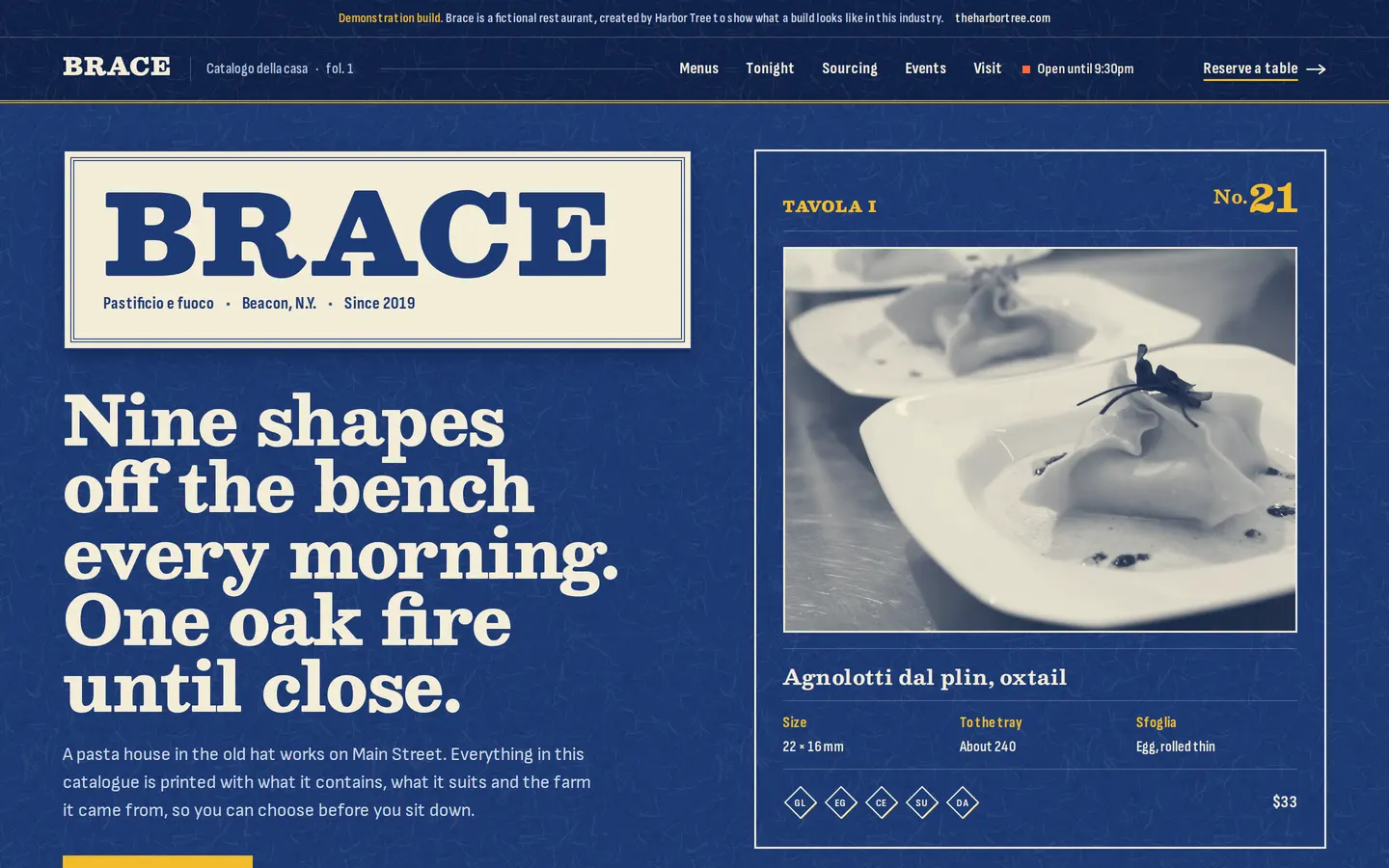
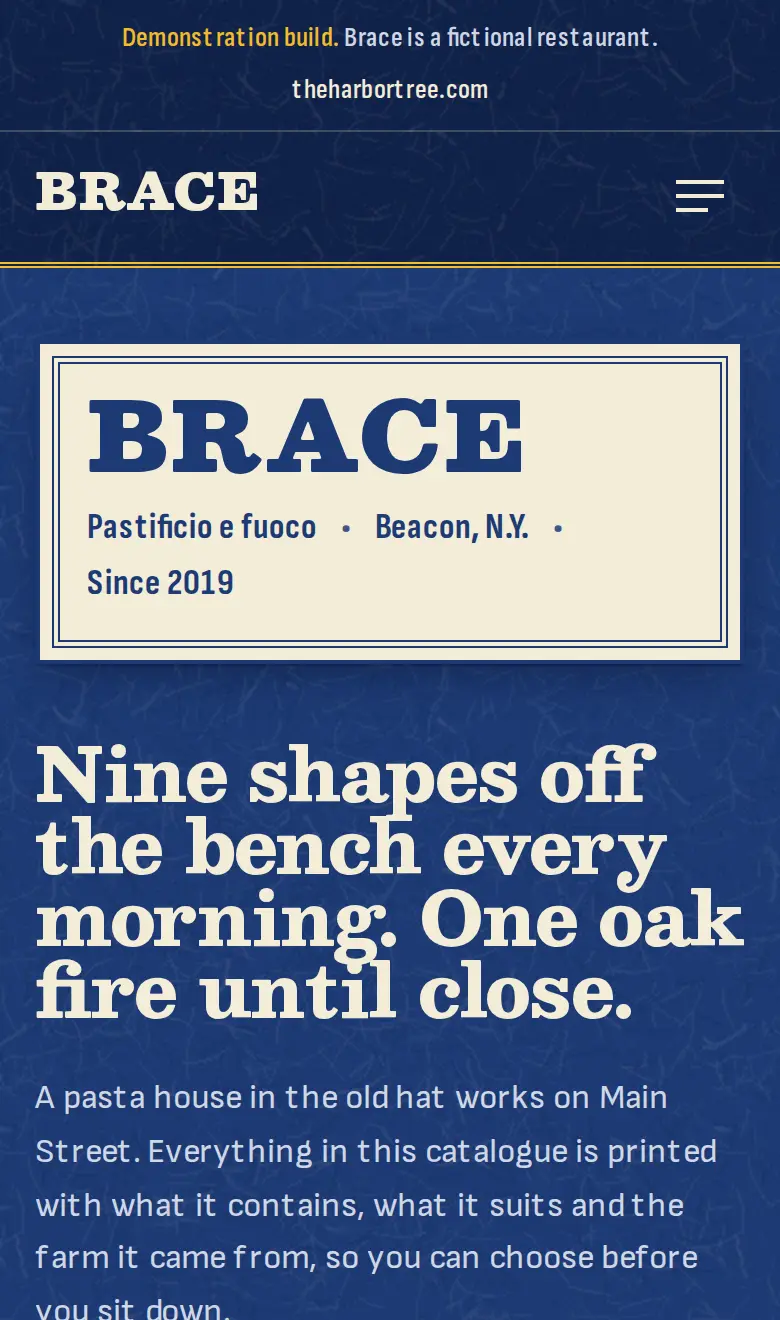
Brace

We haven’t been hired by restaurants yet. Rather than imply otherwise, we built one: a complete restaurant site, every page finished, that you can click through the way one of your customers would.

Brace is invented — the people, the address, the phone number and every figure on it are made up, and the site is kept out of search results on purpose. It is there to be judged as work, not mistaken for a business.

Open the Brace demo (opens in a new tab)

How restaurants get chosen

What actually happens before someone calls you

They are already out, deciding one place at a time

Choosing where to eat is about as short a decision as a local business ever gets. Somebody is already out — walking, or sitting in a car with the engine running — and they are working through whatever the phone put in front of them one place at a time, giving each about as long as it takes to find the menu. Nothing gets written down and nobody returns tomorrow to compare what they saw. A place that cannot answer them inside that window is not rejected so much as skipped.

The strictest eater in the group picks the table

What they open first is the menu, and no other single object on the site comes close to carrying its weight. A group deciding together is not picking the best restaurant; it is picking the one nobody objects to, so whoever has the strictest constraint — the celiac, the vegetarian, the child who will eat plain pasta and nothing else — quietly makes the decision for everyone. They can only make it out of dishes they can actually read, which is why a menu they have to fight to read loses a table of six rather than one diner.

Wrong hours do not lose a visit, they lose a customer

The second question is whether you are open now, and it is the one where being wrong costs most. Someone who reads eleven to eleven, walks fifteen minutes and finds the kitchen closed at nine does not simply choose elsewhere that night — that is the one failure here which actively takes a customer away rather than merely missing one. Hours move constantly, too: a holiday, a buyout, a seasonal change, the Monday you have always been dark. The door is usually the only place any of it is written down.

A second visitor is booking forty people, weeks out

Underneath all of that sits a second visitor with nothing in common with the first. Someone arranging a rehearsal dinner, a retirement party for forty or a catered office lunch is at a desk, weeks ahead, with three or four venues open in tabs, and one of those inquiries is worth a Saturday service. They need capacity, whether a private room can be closed off, whether the whole place can be bought out, what happens about dietary requirements at that scale. One site has to serve them and the person standing on the sidewalk, and almost every restaurant site is built as though only the sidewalk exists.
Where these sites lose the job

Three things most restaurants’ sites get wrong

A menu that has to be pinch-zoomed

The menu is a PDF laid out for print. It downloads rather than opens, arrives sideways, and the visitor ends up dragging a page around a phone to read the appetizers. Nothing inside it is text a search can read either, so the dishes you are known for exist nowhere findable.

Opening hours with no last order time

The footer says eleven to eleven, which is when the doors are unlocked rather than when the kitchen will cook. Someone deciding at eight-forty whether the walk is worth it cannot tell, and the holiday closures and the seasonal Sunday change are written only on the door.

One line about private events, and an email address

The most valuable inquiry the site will ever receive is met with 'we also cater for private functions — do get in touch'. Nothing about how many fit seated, whether there is a room that closes, whether you do drop-off catering, or how far ahead a Saturday has to be held.

What we’d build instead

What a restaurant site has to do

  • A menu built as a page, not a file

    It is the object nearly every visitor came for, and it has to be legible held at arm's length, one-handed, in bad light, by whichever member of the group has the constraint the others are working around.

  • A separate menu page for each service you run

    Brunch, lunch, dinner and the bar list are different rooms at different hours. Someone looking at three on a Tuesday needs the one that applies to them, not one long file they have to search to find out which kitchen is even open.

  • Hours written as service times

    Kitchen close, last orders, the bar running later than the food, and the days you are dark. It is the only thing on the site a visitor can act on wrongly and be punished for, standing outside a locked door in the cold.

  • An events and catering page that asks the inquiry's real questions

    Date, headcount, seated or standing, whether the room has to be private, and how the food is served. Whoever is filling it in is comparing venues that same afternoon, and a reply that answers a real date beats one that opens a correspondence.

  • A route for the parties the booking tool refuses

    Reservation widgets cap at six or eight and then simply decline, which turns away the largest tables in the building. The ceiling and what to do above it belong in plain text on the page, not inside a tool that only knows how to say no.

  • Arrival treated as a question worth answering

    Which door, where to park, what the frontage looks like from the street, whether the patio shares the address. Every guest arrives on foot or in a car against a clock, and a booked table nobody can find becomes a late arrival and a shortened sitting.

Paired with a build

Which services do Maryland restaurants pair with a new website?

A restaurant site goes stale faster than any other kind, so what gets added is usually whatever keeps it true on a Tuesday night six months from now.

  • $99 a month

    Care

    Hours move constantly — a holiday, a buyout, the seasonal Sunday change — and the door is usually the only place any of it gets written down. The menu stays yours to edit; Care is what keeps everything around it worth trusting.

    What Care covers
  • $225 per page

    Extra page

    Brunch, lunch, dinner and the bar list are different rooms at different hours, and the events inquiry is worth a Saturday service on its own. Each earns a page rather than a section of one long file.

    See the add-on menu
  • $349 one-time

    Logo & brand refresh

    The room has a look, and the site, the printed menu and the sign outside ought to be recognizably the same place. Cleaning up the mark and choosing colors and type to carry it is what closes that gap.

    See the add-on menu

Already have a site? The Website Audit is $375 — a written verdict on whether it is worth improving, worth replacing or already fine, and the fee comes off whatever you do next. How the audit works

Not ready for either? Check your Google listing against your site — free, about ten seconds.

What it costs is the same whatever you do.

We price the build, not the industry — the same site costs the same whoever it is for. What each package includes sits on the websites page; what the market charges, and the terms we work on, sit on the pricing page.

Questions from restaurants

The ones we get asked most

Our Instagram does more for us than a website ever has. Why change?

Instagram is where people find you. It is a poor place to be checked.

Three things the feed cannot do:

  • tell somebody out on the sidewalk tonight whether the kitchen is still serving
  • show a full menu to the one person in the group who cannot eat gluten
  • take the details of a forty-person inquiry

The site is not competing with the feed. It is what the feed should be sending people to.

Who updates the menu when we change a dish?

Somebody on your staff, in a browser, in about the time it takes to write the dish out.

Menus rot into PDFs because changing one meant emailing whoever built the site — so the file stays put and the printed version quietly becomes the only accurate one.

This is the part of a restaurant site that has to stay editable by the person who knows what came off the pass this week. It is built that way from the start, not sold back to you as a change request.

Should the menu show prices?

Yes.

A menu with the figures stripped out reads as a warning, and a group that cannot work out roughly what an evening comes to will choose the place that told them.

Published prices also settle the quiet argument happening at the table before anyone walks in.

If yours change often, that is a reason to have a menu you can edit yourself — not a reason to hide them.

We're a small room and we don't take reservations. Does the site still matter?

More, if anything.

Everything a reservation would have settled now has to be settled on the page instead:

  • that you do not take them
  • how the wait list actually works
  • which hours are quiet
  • whether there is anywhere to stand

That question gets asked either way. The only choice is whether your site answers it or the person asking moves on to one that does.

Still holding a question this did not answer? The full FAQ covers what a build costs, how long it takes and what happens after launch — or write to us and you will get a plain-language answer from the person who would build it.

Start a project

Ready for a site
that wins the job?

Tell us what you're working with. You'll get a plain-language reply — and if we're not the right fit, we'll say so and point you somewhere good.

Don't like the first design? Take your money back. What it covers

Want the number first? Build an estimate — a minute, and no email needed.

Not ready? Check your Google listing — free, about ten seconds.

Prefer email? contact@theharbortree.com

Tell us what you need

Three fields. Takes about thirty seconds.

No newsletters, no spam — your details go straight to us and nowhere else.